

Personal del museo · Manual del guardiánMuseum staff · Guardian’s manual
Bienvenido a la casa que guarda la memoriaWelcome to the house that keeps the memory
La Casa Museo El Santuario reúne, en una casa patrimonial, los objetos, las fotografías y las historias que cuentan cómo se formó este municipio del Oriente antioqueño: desde la devoción a San José y la vida de la parroquia, hasta la cocina campesina, la escuela, los oficios, el arte y el comercio.
El recorrido está organizado en once salas. Cada una tiene una descripción breve para leer en el momento y un audio guía con el relato completo de la sala, narrado con las voces y los nombres propios de El Santuario.
Puede seguir el orden propuesto o entrar directamente a la sala donde se encuentre.
Casa Museo El Santuario gathers, inside a heritage house, the objects, photographs and stories that tell how this town in eastern Antioquia came to be: from the devotion to Saint Joseph and the life of the parish, to the country kitchen, the school, the crafts, the arts and local commerce.
The tour is organised in eleven rooms. Each one has a short description to read on the spot and an audio guide with the full story of the room.
You can follow the suggested order or go straight to the room you are standing in.
Audio de bienvenida en preparación. Welcome recording in preparation.
Leer el texto de la bienvenidaRead the welcome script
El audio comienza con un poema de Jorge Robledo Ortiz.
Bienvenidos a la casa que guarda la memoria. La Casa Museo El Santuario reúne, en una casa patrimonial, los objetos, las fotografías y las historias que cuentan cómo se formó este municipio del Oriente antioqueño, desde la devoción a San José y la vida de la parroquia hasta la vida en familia, la escuela, la memoria de los difuntos, el arte, la tertulia, la cocina campesina, el oficio del barro y el comercio.
El recorrido está organizado en once salas. En cada una encontrará una descripción breve para leer en el momento. Junto a las piezas principales hay un código QR que abre el audio guía con su historia.
Puede seguir el orden propuesto, que empieza en la Capilla de San José y termina en El Baratón, o moverse libremente por la casa. Cada audio se entiende por sí solo.
Antes de empezar, le pedimos algunas cosas. No toque las piezas ni ingrese alimentos o bebidas. Si toma fotografías, hágalas sin flash. Para que todos disfruten, procure que no haya más de diez personas por sala.
Los niños deben estar acompañados y las mascotas, con lazo. En la casa viven perros, gatos y gallinas. Por favor, no los alimente. En caso de emergencia, el punto de encuentro es la zona verde grande junto al parqueadero, del lado de la autopista.
Al final de esta página encontrará una encuesta corta que no toma más de dos minutos. Sus respuestas nos ayudan mucho a mejorar el museo. Gracias por su visita.
The audio opens with a poem by Jorge Robledo Ortiz.
Welcome to the house that keeps the memory. Casa Museo El Santuario gathers, inside a heritage house, the objects, photographs and stories that tell how this town in eastern Antioquia came to be: from the devotion to Saint Joseph and the life of the parish to family life, the school, the memory of the dead, art, the tertulia, the country kitchen, the craft of clay and commerce.
The tour is organised in eleven rooms. In each one you will find a short description to read on the spot. Next to the main pieces there is a QR code that opens the audio guide with its story.
You can follow the suggested order, which begins in the Chapel of Saint Joseph and ends in El Baratón, or move freely around the house. Each audio track makes sense on its own.
Before you begin, we ask a few things of you. Please do not touch the pieces or bring in food or drink. If you take photographs, please do so without flash. So that everyone can enjoy the visit, try to keep to no more than ten people per room.
Children must be accompanied and pets kept on a lead. Dogs, cats and hens live in the house. Please do not feed them. In an emergency, the meeting point is the large green area next to the car park, on the motorway side.
At the end of this page you will find a short survey that takes no more than two minutes. Your answers help us a great deal to improve the museum. Thank you for your visit.

Capilla de San JoséChapel of Saint Joseph
El antiguo patrono del valleThe valley’s first patron saint
Audio en preparación. Las grabaciones de esta sala van en audio/es/01-capilla-san-jose/ y el reproductor se activa solo.
Recording in preparation. This room’s files go in audio/en/01-capilla-san-jose/ and the player activates automatically.
Una devoción que permaneceA devotion that endures
Esta capilla honra a San José, cuyo nombre está ligado al territorio donde se encuentra nuestro municipio: el Valle de San José de la Marinilla.
Mucho antes de que Nuestra Señora de Chiquinquirá se convirtiera en la principal advocación religiosa de El Santuario, San José fue uno de los primeros referentes de devoción para los santuarianos.
Los objetos reunidos aquí cuentan parte de esa historia. Son piezas que pertenecieron a sacerdotes, conventos, iglesias y familias del municipio y que, con el paso de los años, encontraron una nueva forma de permanecer entre nosotros.
Esta capilla es también un espacio para recordar que conservar un objeto es, muchas veces, conservar la historia y la fe de quienes lo tuvieron antes que nosotros.
This chapel honours Saint Joseph, whose name is bound to the territory where our town stands: the Valley of San José de la Marinilla.
Long before Our Lady of Chiquinquirá became the main religious devotion of El Santuario, Saint Joseph was one of the first figures of faith for the people of this town.
The objects gathered here tell part of that story. They belonged to priests, convents, churches and families of the municipality, and over the years they found a new way of remaining among us.
This chapel is also a place to remember that keeping an object often means keeping the history and the faith of those who held it before us.
Leer el guion completo de la salaRead the full room script
Esta capilla honra a San José, cuyo nombre está ligado al territorio donde nació nuestro municipio: el Valle de San José de la Marinilla. Antes de que Nuestra Señora de Chiquinquirá se convirtiera en la patrona de El Santuario, San José ya acompañaba la fe de sus primeros pobladores.
Las piezas que hay aquí pertenecieron a sacerdotes, conventos, iglesias y familias del municipio, que con los años las confiaron a esta casa. Entre ellas están la escultura de San José, el misal y el humeral, el comulgatorio, el vitral, la mesa del altar, el sagrario y las bancas. Junto a cada una encontrará un código QR con su historia.
Esta sigue siendo una capilla viva. En ella se celebran, de vez en cuando, eucaristías, homenajes y otros encuentros de la comunidad, aunque no durante los horarios de visita. Le pedimos recorrerla con el respeto que merece un lugar de fe.
ESCULTURA DE SAN JOSÉ
Esta escultura de San José fue realizada en 1936 por el artista santuariano Francisco Gómez Botero, nieto del fundador de la Cerámica de El Salto. La imagen está tallada en madera de roble, recubierta con yeso, y tiene un peso aproximado de 120 kilos. Su presencia en esta capilla nos recuerda una devoción que antecedió a la llegada de Nuestra Señora de Chiquinquirá como principal advocación de los santuarianos.
CRISTO
Esta es la pieza más antigua del museo: un Cristo en la cruz del siglo XVII, anterior incluso a la fundación de El Santuario. No era una imagen de altar, sino un estandarte. Los antepasados del coronel Segundo Villegas lo llevaban al frente de sus tropas como objeto de protección, confiando en que los guardaría en el camino y en el combate.
El coronel Villegas fue bisabuelo de Monseñor Camilo Gómez. La cruz pasó de generación en generación dentro de esa familia, hasta que uno de sus descendientes la donó a esta casa para que siguiera contando su historia.
MISAL EN LATÍN Y HUMERAL
Estos dos objetos pertenecieron al padre Isaías Aristizábal, segundo párroco de El Santuario. El primero es un misal romano, el libro que el sacerdote usa para celebrar la Eucaristía. Este está escrito en latín, porque durante siglos la misa se celebró en esa lengua.
Solo después del Concilio Vaticano II, en los años 60, se empezó a decir en español. Muchos fieles seguían entonces la celebración sin entender cada palabra, pero conocían de memoria sus gestos, sus silencios y sus respuestas.
El segundo es un humeral, o velo humeral, una tela larga que cubre los hombros y las manos del sacerdote. Se usaba para tomar la custodia con el Santísimo Sacramento en las exposiciones y procesiones. Por respeto, el sacerdote no la tocaba con las manos descubiertas. Juntos, estos objetos nos permiten imaginar cómo se vivían las ceremonias religiosas en El Santuario de otras épocas.
COMULGATORIO Y VITRAL
Estos dos elementos pertenecieron a una antigua capilla dedicada a San Antonio, que funcionaba en la casa del padre Pablo Tulio Pineda. Estaba donde hoy se encuentra el Colegio María Auxiliadora, en el espacio que ahora ocupa su biblioteca, y se mantuvo allí hasta los años 60.
El comulgatorio es la baranda donde los fieles se arrodillaban para recibir la comunión. Durante mucho tiempo fue una parte esencial de las iglesias y, con los cambios en la liturgia, fue desapareciendo de muchas de ellas.
Del vitral, lo que viene de la antigua capilla es su forma: el marco y el diseño de la ventana. Los vidrios se hicieron nuevos para esta casa y llevan la azucena, la flor que tradicionalmente representa a San José. Así, una pieza que nació en una capilla dedicada a San Antonio hoy ilumina la capilla de San José.
Por eso estos objetos son más que elementos religiosos: son fragmentos de un lugar que ya no existe. Quien hoy entra a la biblioteca del colegio está pisando el mismo suelo donde antes se rezaba frente a esta baranda.
MESA DEL ALTAR
Esta mesa perteneció al convento de las religiosas concepcionistas de El Santuario. Desde 1938, sobre ella se celebró la Eucaristía día tras día, durante décadas de vida conventual. Más tarde, las hermanas la donaron a esta casa, pero no llegó para quedarse quieta.
Es la mesa del altar de esta capilla y, cuando aquí se celebra una Eucaristía, vuelve a cumplir la misma función que tuvo durante tantos años en el convento. Es una de las pocas piezas del museo que no solo se conserva, sino que todavía se usa.
SAGRARIO
Este cajón sencillo fue el primer sagrario de la hoy Basílica Menor de San Judas Tadeo. El sagrario es el lugar donde se guarda la Eucaristía, el corazón de cualquier iglesia. Este se empezó a usar en 1892, cuando el templo apenas estaba en construcción.
Allí permaneció más de 40 años. En 1935, con la obra terminada, fue reemplazado por un sagrario de plata. Entonces le pasó algo inesperado: terminó en una casa particular donde, durante más de 80 años, sirvió como mesa de noche. Quienes lo usaban guardaban en él sus cosas de todos los días, en el mismo cajón que había guardado lo más sagrado de la parroquia.
En 2022, Isabelita Aristizábal lo donó a la Casa Museo. Después de una vida en el altar y otra en una alcoba, hoy vuelve a estar en una capilla.
BANCAS
Si mira con atención estas bancas, notará que no fueron hechas para una iglesia. Originalmente eran camas matrimoniales de familias santuarianas, fabricadas entre finales del siglo XIX y comienzos del XX. Llegaron al museo, pero no había espacio para exhibirlas como camas. En lugar de guardarlas en una bodega, se decidió darles una nueva vida y adaptarlas como las bancas de esta capilla.
Es curioso: el sagrario de esta misma sala pasó de la iglesia a una alcoba, y estas camas hicieron el camino contrario, de la alcoba a la capilla. Muebles que acompañaron el descanso, los nacimientos y la vida de varias familias hoy acompañan la oración de quienes nos visitan.
RINCÓN DE RELIGIOSIDAD POPULAR
Este rincón guarda una parte muy íntima de la memoria santuariana: las devociones que acompañaban la vida de todos los días. Estas imágenes no estaban en un templo; estaban en las casas, en la sala, en las alcobas, en el pequeño altar donde se rezaba el rosario al caer la tarde.
Aquí hay imágenes de Cristo muy queridas por la gente: el Sagrado Corazón de Jesús, el Divino Rostro, Jesús de la Buena Esperanza y Jesús de Nazaret. Está la Sagrada Familia y, por supuesto, San José. Y están los santos a los que se acudía para cada necesidad: San Roque, San Jerónimo, Santa Rita de Casia, Santa Teresita del Niño Jesús y San Juan de la Cruz. Más que una colección de imágenes, este rincón muestra cómo la fe entraba en las casas y se volvía parte de la familia.
JUICIO FINAL
Este cuadro fue pintado hace unos dos siglos, en la primera mitad del siglo XIX. Pertenece a una tradición de pinturas religiosas que no solo servían para rezar, sino también para enseñar. En una época en la que muchas personas no sabían leer, las imágenes cumplían el papel de un libro. A través de ellas, los fieles conocían las historias de la Biblia y las enseñanzas de la Iglesia.
Esta obra muestra una de las más importantes: el Juicio Final, el momento en que, según la fe cristiana, cada persona responde por su vida. En cuadros como este, Cristo aparece en lo alto como juez. A un lado van los que se salvan, hacia la luz, y al otro, los que se condenan.
Tómense un momento para buscar esas escenas. Para quienes lo miraban entonces, este cuadro recordaba que cada acto de la vida tenía un peso y un destino.
LA ASUNCIÓN DE NUESTRA SEÑORA DE LAS ROCAS
Esta pintura tiene más de tres siglos. Es del siglo XVII, de la misma época que el Cristo en la cruz de la capilla, y es una de las piezas más antiguas del museo. Durante más de 100 años, desde 1854 hasta 1968, estuvo en la iglesia parroquial de Nuestra Señora de Chiquinquirá, donde generaciones de santuarianos rezaron frente a ella.
En 1968 estuvo a punto de ser destruida. Don Orlando Vásquez Aristizábal la rescató, la guardó durante años y finalmente la donó a esta casa.
This chapel honours Saint Joseph, whose name is linked to the territory where our town was born: the Valle de San José de la Marinilla. Before Our Lady of Chiquinquirá became the patron saint of El Santuario, Saint Joseph was already part of the faith of its first settlers.
The pieces here belonged to priests, convents, churches and families of the town, who over the years entrusted them to this house. Among them are the sculpture of Saint Joseph, the missal and the humeral veil, the communion rail, the stained-glass window, the altar table, the tabernacle and the pews. Next to each one you will find a QR code with its story.
This is still a living chapel. From time to time it hosts Masses, tributes and other community gatherings, though not during visiting hours. We ask you to walk through it with the respect that a place of faith deserves.
SCULPTURE OF SAINT JOSEPH
This sculpture of Saint Joseph was made in 1936 by the El Santuario artist Francisco Gómez Botero, grandson of the founder of the El Salto ceramics works. The figure is carved in oak, coated with plaster, and weighs roughly 120 kilos. Its presence in this chapel reminds us of a devotion that came before the arrival of Our Lady of Chiquinquirá as the main devotion of the people of El Santuario.
THE CHRIST FIGURE
This is the oldest piece in the museum: a Christ on the cross from the seventeenth century, older even than the founding of El Santuario. It was not an altar image but a standard. The ancestors of Colonel Segundo Villegas carried it at the head of their troops as an object of protection, trusting that it would keep them safe on the road and in battle.
Colonel Villegas was the great-grandfather of Monsignor Camilo Gómez. The cross passed from generation to generation within that family, until one of its descendants donated it to this house so that it could go on telling its story.
LATIN MISSAL AND HUMERAL VEIL
These two objects belonged to Father Isaías Aristizábal, the second parish priest of El Santuario. The first is a Roman missal, the book the priest uses to celebrate the Eucharist. This one is written in Latin, because for centuries Mass was celebrated in that language.
Only after the Second Vatican Council, in the 1960s, did people begin to say it in Spanish. Back then, many of the faithful followed the celebration without understanding every word, but they knew its gestures, its silences and its responses by heart.
The second is a humeral, or humeral veil, a long cloth that covers the priest’s shoulders and hands. It was used to take up the monstrance holding the Blessed Sacrament during exposition and in processions. Out of reverence, the priest did not touch it with bare hands. Together, these objects help us imagine how religious ceremonies were lived in the El Santuario of other times.
COMMUNION RAIL AND STAINED GLASS
These two pieces belonged to an old chapel dedicated to Saint Anthony, which was in the house of Father Pablo Tulio Pineda. It stood where the Colegio María Auxiliadora is today, in the space now occupied by its library, and remained there until the 1960s.
The communion rail is the railing at which the faithful knelt to receive Communion. For a long time it was an essential part of churches, and with the changes in the liturgy it gradually disappeared from many of them.
Of the stained-glass window, what comes from the old chapel is its form: the frame and the design of the window. The glass was made new for this house and bears the lily, the flower that traditionally represents Saint Joseph. So a piece that was born in a chapel dedicated to Saint Anthony now lights the Chapel of Saint Joseph.
That is why these objects are more than religious items: they are fragments of a place that no longer exists. Anyone who walks into the school library today is treading the same floor where people once prayed before this rail.
THE ALTAR TABLE
This table belonged to the convent of the Conceptionist Sisters of El Santuario. From 1938 onwards, Mass was celebrated on it day after day, through decades of convent life. Later the sisters donated it to this house, but it did not come here to stand still.
It is the altar table of this chapel, and whenever Mass is celebrated here it once again fulfils the same function it had for so many years in the convent. It is one of the few pieces in the museum that is not only preserved but still in use.
THE TABERNACLE
This simple box was the first tabernacle of what is now the Minor Basilica of Saint Jude Thaddeus. The tabernacle is where the Eucharist is kept, the heart of any church. This one came into use in 1892, when the church was still under construction.
It stayed there for more than 40 years. In 1935, with the building finished, it was replaced by a silver tabernacle. Then something unexpected happened: it ended up in a private home, where for more than 80 years it served as a bedside table. Those who used it kept their everyday things in it, in the same box that had once held the most sacred thing in the parish.
In 2022, Isabelita Aristizábal donated it to the Casa Museo. After one life on the altar and another in a bedroom, today it is back in a chapel.
THE PEWS
If you look closely at these pews, you will notice that they were not made for a church. They were originally marriage beds belonging to families of El Santuario, made between the late nineteenth and early twentieth centuries. They came to the museum, but there was no room to display them as beds. Instead of putting them away in a storeroom, it was decided to give them a new life and adapt them as the pews of this chapel.
It is a curious thing: the tabernacle in this same room went from the church to a bedroom, and these beds made the opposite journey, from the bedroom to the chapel. Furniture that accompanied the rest, the births and the lives of several families now accompanies the prayers of those who visit us.
CORNER OF POPULAR DEVOTION
This corner holds a very intimate part of El Santuario’s memory: the devotions that accompanied everyday life. These images were not in a church; they were in homes, in the living room, in the bedrooms, on the little altar where the rosary was prayed as evening fell.
Here are images of Christ much loved by the people: the Sacred Heart of Jesus, the Holy Face, Jesus of Good Hope and Jesus of Nazareth. There is the Holy Family and, of course, Saint Joseph. And there are the saints people turned to for every need: Saint Roch, Saint Jerome, Saint Rita of Cascia, Saint Thérèse of the Child Jesus and Saint John of the Cross. More than a collection of images, this corner shows how faith entered the home and became part of the family.
THE LAST JUDGEMENT
This painting was made about two centuries ago, in the first half of the nineteenth century. It belongs to a tradition of religious paintings that served not only for prayer but also for teaching. At a time when many people could not read, images did the work of a book. Through them, the faithful came to know the stories of the Bible and the teachings of the Church.
This work shows one of the most important: the Last Judgement, the moment when, according to Christian faith, each person answers for their life. In paintings like this one, Christ appears on high as judge. On one side go the saved, towards the light, and on the other, the damned.
Take a moment to look for those scenes. For those who looked at it back then, this painting was a reminder that every act in life carried weight and led to a destiny.
THE ASSUMPTION OF OUR LADY OF THE ROCKS
This painting is more than three centuries old. It dates from the seventeenth century, the same period as the Christ on the cross in the chapel, and it is one of the oldest pieces in the museum. For more than 100 years, from 1854 to 1968, it hung in the parish church of Our Lady of Chiquinquirá, where generations of people from El Santuario prayed before it.
In 1968 it was on the verge of being destroyed. Don Orlando Vásquez Aristizábal rescued it, kept it for years and finally donated it to this house.

La SacristíaThe Sacristy
La Iglesia y la vida santuarianaThe Church and local life
Audio en preparación. Las grabaciones de esta sala van en audio/es/02-sacristia/ y el reproductor se activa solo.
Recording in preparation. This room’s files go in audio/en/02-sacristia/ and the player activates automatically.
La Iglesia y la vida santuarianaThe Church and life in El Santuario
En El Santuario, la Iglesia ha sido mucho más que un espacio para la celebración de la fe. Durante generaciones ha acompañado la educación, las celebraciones, las tradiciones, la organización comunitaria y buena parte de la vida cotidiana de sus habitantes.
Por la presencia histórica de numerosos sacerdotes nacidos en el municipio, El Santuario ha sido conocido como la “Ciudad Levítica de Antioquia”.
Esta sala reúne fotografías, objetos y obras que permiten acercarnos a esa historia: procesiones, catequesis, convivencias, visitas a las veredas y otras actividades en las que la parroquia y la comunidad construyeron juntas una parte importante de la identidad santuariana.
In El Santuario the Church has been far more than a place of worship. For generations it has accompanied education, celebrations, traditions, community organisation and much of daily life.
Because so many priests were born here, El Santuario has been known as the “Levitical City of Antioquia”.
This room brings together photographs, objects and works that open a window onto that history: processions, catechism, retreats, visits to the rural villages, and other activities through which the parish and the community built an important part of the local identity.
Leer el guion completo de la salaRead the full room script
En las iglesias, la sacristía es el lugar donde el sacerdote se prepara antes de la celebración y donde se guardan los objetos del culto. Esta sala toma ese nombre para contar una historia más amplia: la de la Iglesia en la vida de El Santuario.
Aquí la parroquia ha sido mucho más que un lugar de oración. Durante generaciones ha acompañado la educación, las fiestas, las tradiciones, la organización de la comunidad y buena parte de la vida diaria de sus habitantes.
Del municipio han salido tantos sacerdotes que El Santuario es conocido como la Ciudad Levítica de Antioquia. El nombre viene de los levitas, la tribu del pueblo de Israel dedicada al servicio del templo.
Basta un ejemplo: en la familia del padre Jesús Antonio Gómez, el padre Toñito, hubo 14 hijos, y de ellos salieron cuatro sacerdotes y una religiosa. Él mismo está hoy en proceso de canonización, y en esta sala encontrará un audio dedicado a su historia. Esta sala reúne fotografías, objetos y obras de esa historia compartida: procesiones, catequesis, convivencias y visitas a las veredas.
EZEQUIEL BOTERO
El hombre de este retrato aparece vestido de sacerdote, pero nunca llegó a serlo. Ezequiel Botero soñó desde joven con el sacerdocio y entró al seminario. Después de varios años decidió retirarse, porque sentía que no era digno de recibir ese sacramento.
Se fue entonces a la vereda El Valle de María, donde construyó una pequeña capilla y vivió dedicado a la oración. La gente de la vereda lo llamaba con cariño Ezequielito.
Cuenta la tradición que un día de 1913 los vecinos empezaron a sentir un aroma extraño, parecido al de las rosas. Siguieron el olor hasta la capilla, y allí encontraron a Ezequiel ya fallecido. Para ellos, aquello solo tenía una explicación: había muerto en olor de santidad, como se decía de las personas cuya vida había agradado a Dios.
La historia impresionó tanto que se le encargó un retrato al pintor Francisco Antonio Moreno Ramírez. Su primo, Monseñor José Ignacio Botero, quien guió espiritualmente a los santuarianos durante más de 50 años, pidió que lo pintaran vestido de sacerdote. Era una forma de decir que Ezequiel había alcanzado en la eternidad lo que no quiso aceptar en vida.
JERARQUÍA DE LA ACCIÓN CATÓLICA
Este cuadro es una réplica de una obra original del artista Claver Ramírez, pintada en los años 30. Lo encargó Monseñor José Ignacio Botero, el mismo que pidió retratar a Ezequiel como sacerdote. Monseñor Botero era conocido por su manera didáctica de enseñar la doctrina, y esta pintura era una de sus herramientas.
En esos años, la Iglesia impulsaba la Acción Católica, un movimiento que invitaba a los laicos, es decir, a las personas que no eran sacerdotes ni religiosos, a participar activamente en la vida de la Iglesia. El cuadro lo explica con una imagen. Recórralo de arriba abajo: en lo más alto está Jesús; debajo aparecen el Papa, el Arzobispo, el Obispo y el Párroco. Al final están la comunidad y los niños, que también hacen parte de esa misión.
La obra traza además un camino simbólico entre el Vaticano y la parroquia de Nuestra Señora de Chiquinquirá, como diciendo que lo que se decidía en Roma llegaba hasta la última familia de El Santuario.
LOS HIJOS DE LA PROMESA
Don Ramón Giraldo y doña Ignacia Zuluaga llevaban más de diez años casados y no habían podido tener hijos. Habían oído hablar de los milagros de Nuestra Señora de Chiquinquirá y decidieron ir a pedirle ayuda a su santuario en Boyacá. Hicieron el viaje parte a pie y parte en mula, cruzando montañas durante semanas, y allí le hicieron una promesa: si les daba hijos, al menos uno de ellos sería para Dios.
Según la memoria de la familia, la Virgen respondió. Tuvieron siete hijos y cumplieron con creces: dos de ellos se hicieron sacerdotes y una hija se hizo religiosa.
Uno de esos hijos fue el padre Nicolás Giraldo Zuluaga, el primer párroco de El Santuario. En 1838 encabezó, junto con otros vecinos, la lucha para que El Santuario dejara de depender de Marinilla y se convirtiera en parroquia y municipio propio, y presidió su primer concejo. Su hermano Salvador fue el vicepresidente de ese mismo concejo. Los hijos de la promesa ayudaron a fundar el pueblo que hoy conocemos.
La promesa no se quedó en esa generación: se convirtió en una tradición que los descendientes de la familia Giraldo mantuvieron durante años. Lo que ve aquí es una fotografía del cuadro que los recuerda. El original se conserva en la casa cural de la parroquia de Nuestra Señora de Chiquinquirá. En él aparecen varios sacerdotes de la familia, entre ellos el padre Nicolás.
PADRE ANTONIO GÓMEZ
Este es el retrato del padre Jesús Antonio Gómez Gómez, a quien todo El Santuario conoce con cariño como el padre Toñito. Nació el 26 de marzo de 1895 en la vereda El Carmelo, en una familia campesina y muy creyente. Se ordenó sacerdote en 1922 y durante 20 años fue director espiritual del Seminario de Medellín.
Por sus manos pasaron generaciones enteras de sacerdotes, y por eso lo llamaron el Apóstol de los Sacerdotes. Quienes lo conocieron lo recuerdan como un hombre humilde que sabía escuchar y aconsejar.
Murió en Medellín el 23 de marzo de 1971. Su cuerpo fue traído de vuelta a su pueblo y hoy reposa en la Basílica de San Judas Tadeo, donde muchos fieles lo visitan para pedir su intercesión. La Iglesia lo declaró venerable, el título que reconoce que vivió las virtudes cristianas de manera heroica. Es el primer paso hacia la beatificación.
Su historia es una de las razones por las que El Santuario es conocido como la Ciudad Levítica de Antioquia. Este retrato lo pintó Claver Ramírez, el mismo artista del cuadro de la Acción Católica, y más tarde lo restauró Argiro Quinchía.
In churches, the sacristy is where the priest prepares before the celebration and where the objects used in worship are kept. This room takes that name to tell a broader story: that of the Church in the life of El Santuario.
Here the parish has been much more than a place of prayer. For generations it has accompanied education, festivities, traditions, the organisation of the community and a good part of the daily life of its people.
So many priests have come from the town that El Santuario is known as the Levitical City of Antioquia. The name comes from the Levites, the tribe of the people of Israel devoted to the service of the temple.
One example is enough: in the family of Father Jesús Antonio Gómez, Father Toñito, there were 14 children, and from them came four priests and a nun. He himself is now on the path to canonisation, and in this room you will find an audio track devoted to his story. This room brings together photographs, objects and works from that shared history: processions, catechism classes, community retreats and visits to the rural districts.
EZEQUIEL BOTERO
The man in this portrait is dressed as a priest, but he never became one. From a young age Ezequiel Botero dreamed of the priesthood, and he entered the seminary. After several years he decided to leave, because he felt he was not worthy of receiving that sacrament.
He then went to the rural district of El Valle de María, where he built a small chapel and lived a life devoted to prayer. The people of the district affectionately called him Ezequielito.
Tradition has it that one day in 1913 the neighbours began to notice a strange fragrance, like that of roses. They followed the scent to the chapel, and there they found Ezequiel, already dead. For them it could mean only one thing: he had died in the odour of sanctity, as was said of people whose lives had pleased God.
The story made such an impression that a portrait was commissioned from the painter Francisco Antonio Moreno Ramírez. His cousin, Monsignor José Ignacio Botero, who was the spiritual guide of the people of El Santuario for more than 50 years, asked for him to be painted dressed as a priest. It was a way of saying that in eternity Ezequiel had attained what he would not accept in life.
THE HIERARCHY OF CATHOLIC ACTION
This painting is a replica of an original work by the artist Claver Ramírez, painted in the 1930s. It was commissioned by Monsignor José Ignacio Botero, the same man who asked for Ezequiel to be portrayed as a priest. Monsignor Botero was known for his didactic way of teaching doctrine, and this painting was one of his tools.
In those years the Church was promoting Catholic Action, a movement that invited the laity —that is, people who were neither priests nor members of religious orders— to take an active part in the life of the Church. The painting explains it with an image. Look at it from top to bottom: at the very top is Jesus; below him are the Pope, the Archbishop, the Bishop and the parish priest. At the bottom are the community and the children, who are also part of that mission.
The work also traces a symbolic path between the Vatican and the parish of Our Lady of Chiquinquirá, as if to say that what was decided in Rome reached even the last family in El Santuario.
THE CHILDREN OF THE PROMISE
Don Ramón Giraldo and doña Ignacia Zuluaga had been married for more than ten years and had not been able to have children. They had heard of the miracles of Our Lady of Chiquinquirá and decided to go and ask for her help at her shrine in Boyacá. They made the journey partly on foot and partly by mule, crossing mountains for weeks, and there they made her a promise: if she gave them children, at least one of them would be for God.
According to the family’s memory, the Virgin answered. They had seven children and more than kept their word: two of them became priests and a daughter became a nun.
One of those sons was Father Nicolás Giraldo Zuluaga, the first parish priest of El Santuario. In 1838, together with other residents, he led the struggle for El Santuario to stop depending on Marinilla and become a parish and municipality in its own right, and he presided over its first town council. His brother Salvador was vice-president of that same council. The children of the promise helped to found the town we know today.
The promise did not end with that generation: it became a tradition that the descendants of the Giraldo family kept up for years. What you see here is a photograph of the painting that remembers them. The original is kept in the parish house of the parish of Our Lady of Chiquinquirá. It shows several priests of the family, among them Father Nicolás.
FATHER ANTONIO GÓMEZ
This is the portrait of Father Jesús Antonio Gómez Gómez, whom all of El Santuario affectionately knows as Father Toñito. He was born on 26 March 1895 in the rural district of El Carmelo, into a deeply devout campesino family. He was ordained a priest in 1922 and for 20 years was spiritual director of the Seminary of Medellín.
Whole generations of priests passed through his hands, and that is why he was called the Apostle of Priests. Those who knew him remember him as a humble man who knew how to listen and give advice.
He died in Medellín on 23 March 1971. His body was brought back to his home town, and today he rests in the Basilica of Saint Jude Thaddeus, where many of the faithful visit him to ask for his intercession. The Church declared him Venerable, the title that recognises that he lived the Christian virtues to a heroic degree. It is the first step towards beatification.
His story is one of the reasons why El Santuario is known as the Levitical City of Antioquia. This portrait was painted by Claver Ramírez, the same artist who painted the Catholic Action picture, and was later restored by Argiro Quinchía.
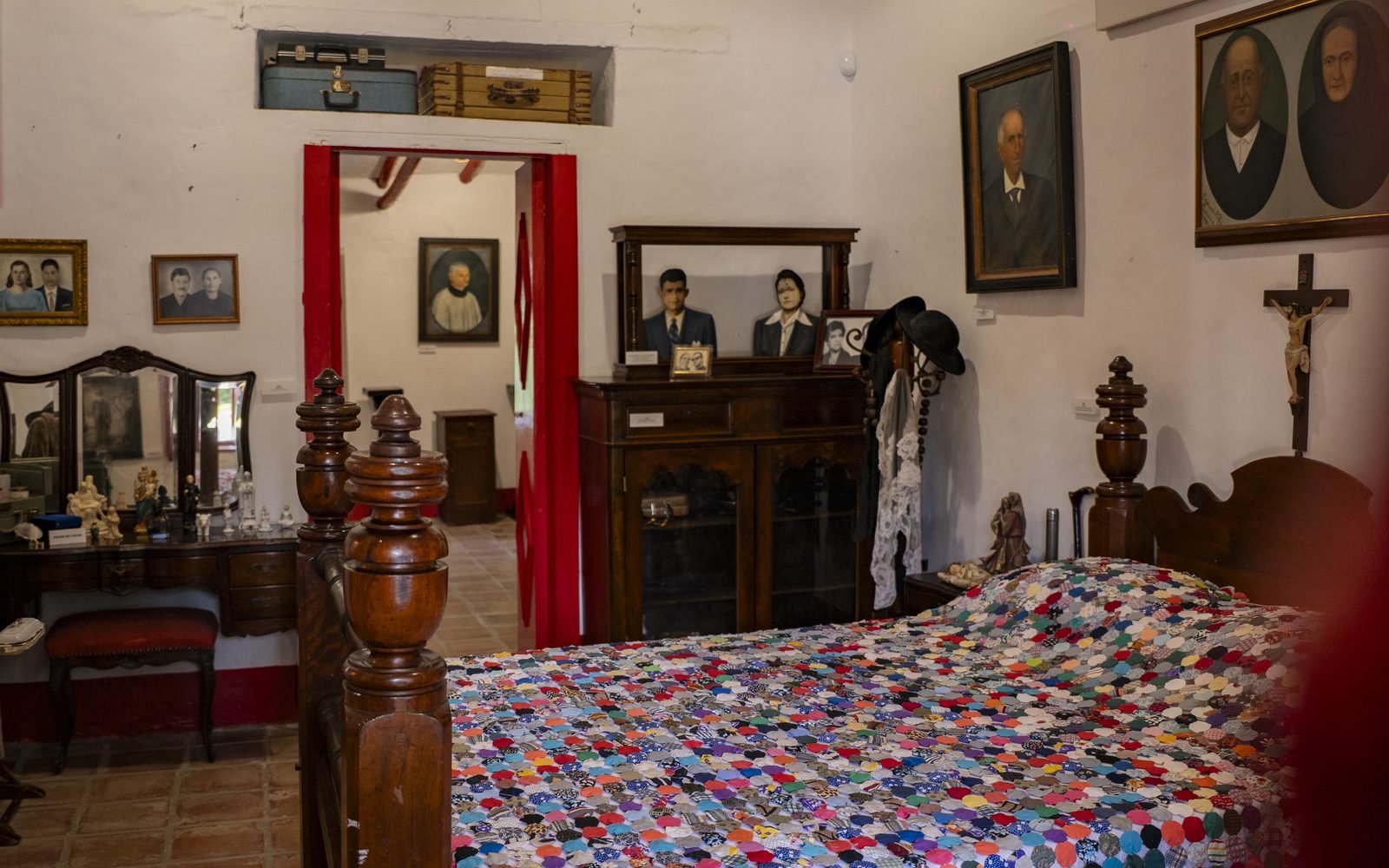
Sala MatrimonialThe Marriage Room
El matrimonio como instituciónMarriage as an institution
Audio en preparación. Las grabaciones de esta sala van en audio/es/03-sala-matrimonial/ y el reproductor se activa solo.
Recording in preparation. This room’s files go in audio/en/03-sala-matrimonial/ and the player activates automatically.
En este espacio honramos el matrimonio como una de las instituciones que ha acompañado la construcción de nuestras familias y de nuestra comunidad.
Aquí podemos acercarnos a las formas en que nuestros antepasados vivieron el amor, la familia y la vida en pareja: desde las ceremonias y las fotografías matrimoniales, hasta los objetos que acompañaban la intimidad y la vida cotidiana del hogar.
This room honours marriage as one of the institutions that shaped our families and our community.
Here we can come closer to the ways our ancestors lived love, family and life as a couple: from ceremonies and wedding photographs to the objects that accompanied the intimacy and daily life of the home.
Leer el guion completo de la salaRead the full room script
Esta sala está dedicada al matrimonio, una de las instituciones que dio forma a las familias santuarianas y, con ellas, al pueblo entero. Aquí puede asomarse a la manera en que nuestros abuelos vivieron el amor y la vida en pareja: las ceremonias y las fotografías de boda, pero también los objetos más íntimos del hogar, los que no se mostraban a las visitas.
Está la cama, centro de la alcoba. Está el tocador, donde uno se arreglaba frente al espejo; el neceser, con los objetos de aseo personal, y el costurero, donde se remendaba, se bordaba y se preparaba el ajuar. Está también el aguamanil, la jarra y la palangana con que la gente se lavaba cada mañana, en tiempos en que el agua no llegaba por tubería a las casas.
Si viene de la capilla, recordará que sus bancas fueron alguna vez camas matrimoniales. Aquí puede ver cómo eran esas camas en su lugar original: la alcoba donde empezaba cada familia.
Durante buena parte del siglo XX, casarse en El Santuario tenía sus propias reglas. Mire las fotografías: muchas novias no están de blanco. Era común que los novios vistieran trajes oscuros, de corte sastre.
Monseñor José Ignacio Botero, el mismo del retrato de Ezequiel, promovía esta costumbre para recordar que el matrimonio era para toda la vida, con sus alegrías y también con sus sacrificios y dificultades. Algunas parejas buscaban un punto intermedio y combinaban el blanco con el negro, lo que se llamaba «semiluto»: el negro por los sacrificios, el blanco por las alegrías.
Las bodas se celebraban muy temprano, casi al amanecer. En esa época, para comulgar había que ayunar desde la medianoche, y como los novios recibían la comunión en su misa de matrimonio, casarse temprano era la forma de no pasar la mañana entera sin comer.
Pero no todos siguieron las reglas. En la parte superior verá a una pareja que decidió casarse de noche y vestida de gala, desafiando las costumbres de su tiempo. Una imagen que nos recuerda que cada generación también cambia las tradiciones.
En esta sala encontrará además otros códigos QR con historias de parejas y familias santuarianas. Escúchelas: son las que le dan vida a estos objetos.
MATRIMONIO SERNA ZULUAGA
El sol apenas empezaba a vencer la neblina de la madrugada cuando don Miguel Antonio Serna Gómez y doña Blanca Fabiola Zuluaga Gómez salieron, ya casados, en el tradicional desfile matrimonial por las calles de El Santuario. Es la misma costumbre de la que habla el audio de esta sala: las bodas al amanecer.
Antonio Botero tomó esta fotografía hacia las seis de la mañana, en la esquina de la Casa Cural y la Farmacia Santa Cruz, sobre la calle 50, la calle José María Córdova. Aunque era temprano, el pueblo ya estaba despierto. Mire con atención: niños descalzos, muchachas vestidas para la ocasión, hombres de sombrero, mujeres que observan desde las aceras, vecinos que dejaron por unos minutos lo que estaban haciendo.
Nadie parece indiferente al paso de los recién casados. En esa época, un matrimonio no era solo un asunto de familia: era un acontecimiento del pueblo.
La foto guarda también un retrato del pueblo de entonces. Al fondo se ve una esquina del parque principal, donde estaba la casa de don Julio Giraldo. Allí funcionó durante un tiempo la Escuela Industrial, y años después se levantó el Teatro José María Córdova, que varias generaciones de santuarianos recuerdan con cariño. Más allá, el costado sur de la plaza todavía se pierde en la neblina, y en el parque esperan algunos automóviles estacionados.
Cada rostro en la acera, cada niño curioso y cada edificio del fondo cuentan su propia historia. Juntos forman el retrato de un pueblo que todavía vivía sus alegrías en comunidad.
Más de medio siglo después, aquella neblina se disipó hace mucho. Pero gracias al lente de Antonio Botero sigue intacto el recuerdo de un pueblo que salió a la calle a acompañar el comienzo de una nueva vida.
MATRIMONIO GÓMEZ GIRALDO · 1958
Esta fotografía la tomó don Antonio Botero el 25 de julio de 1958, el día en que se casaron don Luis Ángel Gómez Ramírez y doña Helda Myriam Giraldo Gómez. En un pueblo donde casi todos se apellidaban Gómez, Giraldo o Zuluaga, los apellidos no alcanzaban para saber de quién se hablaba; por eso cada rama de la familia tenía su apodo.
Él era de los Gómez conocidos como «los Salteños», y ella, de los Giraldo, a quienes todos llamaban «los Avelinos». Así, con solo decir el apodo, cualquiera en El Santuario sabía de qué familia se trataba.
De este matrimonio nacieron, entre otros hijos, el doctor Óscar Gómez, escritor prolífico; Ancízar Gómez, recordado cantinero del pueblo, y Raúl Gómez Giraldo, que llegó a ser alcalde del municipio. Una sola pareja dio al pueblo letras, tertulia y gobierno.
MATRIMONIO ZULUAGA ARISTIZÁBAL · 1928
El 27 de diciembre de 1928, el fotógrafo Floro Ezequiel Zuluaga retrató a los recién casados Francisco Zuluaga Salazar, a quien todos llamaban con cariño «el maestro Pacho», y Julia Rosa Aristizábal Ramírez. Los casó Monseñor José Ignacio Botero, párroco de El Santuario entre 1917 y 1962.
Lo primero que sorprende de esta imagen es su modernidad. Fue tomada en un pueblo pequeño del Oriente antioqueño, pero podría pasar por un retrato de estudio de Medellín, Buenos Aires o Nueva York. Parece una escena del cine mudo de aquellos años.
Fíjese en Julia Rosa. Lleva un sombrero tipo cloche, el más representativo de la moda femenina de los años 20 en todo el mundo. Perlas, pendientes, un vestido de líneas sencillas y un maquillaje discreto.
A su lado, Francisco vistió un traje de tres piezas, cuello alto, corbata con pasador y un reloj de bolsillo cuya cadena apenas asoma sobre el chaleco. El peinado marcado y el bigote fino completan la imagen. Nada es improvisado.
Las familias santuarianas de entonces no eran ricas, pero para las grandes ocasiones se vestían con el mayor esmero. Presentarse dignamente ante la comunidad y ante la cámara era parte de la celebración. Quizá por eso El Santuario conserva hasta hoy una cultura muy fuerte de la presentación personal: salones de belleza, almacenes de moda, estudios fotográficos y empresas de eventos siguen siendo parte importante de la vida del municipio.
Floro Ezequiel Zuluaga, conocido en el pueblo como «Florito», fue el mismo que instaló la primera planta de energía de El Santuario, la que trajo el padre Pablo Tulio Pineda: un hombre que le dio al pueblo la luz eléctrica y también la fotografía, y entendió muy bien esa sensibilidad. En lugar de llenar la escena de muebles y adornos, eligió un fondo sobrio y un encuadre cercano para que todos se concentren en los rostros.
Las miradas son serenas, no sonríen. En la fotografía de la época, la seriedad era una forma de respeto por un momento que quedaría para siempre. Casi un siglo después, la imagen sigue pareciendo actual. En ella se reconoce algo que ha acompañado por generaciones a los santuarianos: la convicción de que los momentos importantes de la vida merecen vivirse y recordarse con elegancia.
MATRIMONIO SERNA GÓMEZ · 1959
El 21 de mayo de 1959, Antonio Botero fotografió a Pedro Enrique Serna Gómez, de 33 años, y a Mariela Gómez Serna, de 23, el día de su matrimonio. Él era hijo de Luis Serna y Rosario Gómez; ella, de Laura Serna y de Manuel José Gómez, a quien en El Santuario conocían como «Cacao». Los casó el padre Francisco Luis Gómez.
A primera vista, la imagen transmite serenidad. No hay gestos exagerados ni poses teatrales. Esa expresión contenida no es frialdad: en el retrato formal de la época, la seriedad era una manera de mostrar respeto y dignidad en uno de los días más importantes de la vida.
Antonio Botero cuidó cada detalle. El fondo pintado, un poco desenfocado, apenas sugiere un paisaje. La vieja puerta del estudio y el piso de tablas dan profundidad sin robar protagonismo. Todo está dispuesto para que la mirada se quede en la pareja.
Pedro Enrique lleva la elegancia de los hombres santuarianos de finales de los 50: sombrero de ala ancha, traje oscuro bien cortado, corbata estampada con pisacorbata y zapatos brillantes. Mariela, en cambio, trae aires nuevos. Recordará que en el audio de esta sala hablamos de las novias vestidas de oscuro.
Ella ya viste de blanco: mangas cortas abullonadas, pliegues finos en el pecho y un ancho lazo oscuro en la cintura. Completan su imagen un bolso pequeño, zapatos de tacón claro, reloj de pulsera y unas pocas joyas. Es una mujer joven que sigue la moda de su tiempo, cuando vestirse para la boda empezaba a ser también una elección personal.
Fíjese en la postura. Ella toma suavemente el brazo de su esposo y él se mantiene firme y sereno. No hay rigidez entre los dos, pero tampoco exhibición de afecto. Ese gesto sencillo basta para expresar la confianza con que empezaban su vida juntos.
Esta fotografía retrata a una generación que vivía entre dos mundos. Todavía guardaba la solemnidad de las costumbres heredadas, pero ya se abría a las nuevas formas de vestir y de celebrar que llegarían con los años 60. Como en muchas obras de Antonio Botero, su fuerza está en lo sencillo: dos personas, un fondo bien pensado y la luz precisa.
MATRIMONIO OROZCO QUINTERO
El 30 de abril de 1956, Monseñor José Ignacio Botero casó a don Eladio Orozco Gómez, de 51 años, con María del Carmen Quintero Montes, de 31. Él, nacido en El Santuario en 1905, era hijo de Rafael Orozco y Hortensia Gómez, y había enviudado de Filomena Ramírez. Ella era hija de Fidel Quintero y María Jesús Montes.
Don Antonio Botero les tomó esta fotografía. Posan con la solemnidad de los retratos de la época: él, sobrio; ella, serena y firme. Por la foto no podríamos saber qué sentían, pero esta imagen tiene una historia.
Durante décadas estuvo guardada, sin que nadie la reclamara, en un antiguo archivo fotográfico del pueblo. Cuando por fin llegó a manos de doña María del Carmen, ella la vio por primera vez desde el día de su boda. Se echó a llorar y, mientras besaba la foto, solo alcanzaba a repetir: «Mi Mono, mi Mono hermoso».
Ella se había casado tarde para su época, cuando muchas santuarianas se casaban siendo casi niñas. Él le llevaba 20 años y ya conocía la viudez.
Todo empezó de la forma más sencilla. María del Carmen lo veía pasar todos los días frente a su casa. Sabían quién era el otro, pero casi no hablaban: solo se miraban, hasta que un día él rompió el silencio con una pregunta: «Carmen, ¿le hacemos?». Y ella contestó con la misma sencillez: «Hagámole».
Con los años, doña María del Carmen contaba entre risas lo inocente que llegó al matrimonio. Creía que casarse era cocinarle al esposo y arreglarle la ropa. Por eso, cuando don Eladio se le acercaba con cariño, ella se subía al zarzo de la casa.
Desde abajo él le decía: «Bajate de ahí, Carmen», y ella: «Yo por ahora no me voy a bajar». Cuando le preguntaban cómo habían formado su familia, sonreía con pudor y respondía: «Ahí nos fuimos conociendo».
Don Eladio murió en 1974. Ella vivió hasta los 100 años, y al final de su vida contó que algunas noches se despertaba sobresaltada con un pensamiento. Su Mono había tenido otra esposa antes que ella, y se preguntaba: «¿A quién le dará Dios al Mono cuando yo me muera?».
Esta foto ya no es solo el registro de una boda. Es la huella de un amor que nació entre miradas, creció con paciencia, humor y respeto, y duró toda una vida en la memoria de una mujer que nunca dejó de llamar a su esposo de la misma manera: «Mi Mono hermoso».
MATRIMONIO BOTERO GÓMEZ · 1961
El 23 de febrero de 1961, el padre Jairo Pineda casó a Martín Emilio Botero Serna, hijo de Alberto Botero y Carmen Eva Serna, con Blanca Fabiola Gómez Serna, de 22 años. Ella era hija de Manuel José Gómez, «Cacao», y de Laura Serna, y hermana de Mariela, la novia de 1959 que puede ver en otra fotografía de esta sala. Martín Emilio, como su padre y su abuelo, era carnicero, uno de los oficios tradicionales del pueblo.
Antonio Botero los retrató en el momento de cortar la torta. Las manos están unidas sobre el cuchillo y los dos miran el primer trozo que está por separarse. Ninguno mira a la cámara: parece un momento vivido, no una pose.
Pero es imposible no mirar la torta. Está montada sobre varias mesas para que se vea todavía más alta, con varios cuerpos superpuestos, columnas, flores de azúcar y una pequeña pareja de novios en el centro. Es casi una obra de arquitectura.
En El Santuario había una pregunta que se hacía siempre, entre sonrisas, después de una boda: «¿De cuántos pisos fue la torta?». La respuesta no hablaba solo del postre: era la manera de medir el tamaño de la fiesta, cuántos invitados hubo y cuánto se habían esforzado las familias.
Fíjese también en el vestido de Blanca Fabiola: chaqueta ajustada, broche, falda recta y un peinado muy elaborado. Es la moda urbana de comienzos de los 60, que llegaba al pueblo y dejaba atrás los vestidos voluminosos de antes. Martín Emilio lleva un traje oscuro de corte clásico y una corbata discreta.
Detrás de ellos, un espejo agranda el espacio y duplica la torta. Hay cintas colgadas en la pared, una planta a un lado y el piso de tablas de una casa, porque así eran estas fiestas: por un día, la sala de la familia se convertía en salón de recepción.
Más de seis décadas después, la foto conserva esa costumbre que todavía recuerdan muchos santuarianos: medir una boda con una sola pregunta. ¿De cuántos pisos fue la torta?
MATRIMONIO CASTAÑO ZULUAGA · 1962
El 2 de junio de 1962, el padre Marcos Gómez casó a José Jesús Castaño Ramírez, de 32 años, hijo de Jesús María Castaño y Dolores Ramírez, con Rosalba Zuluaga Zuluaga, de 17, nacida en Granada e hija de Ramón Emilio Zuluaga y Judith Zuluaga. Antonio Botero les tomó esta fotografía.
A primera vista es un retrato de estudio como tantos de la época: los esposos de pie, serenos, frente al telón pintado, la puerta de utilería y la cortina con que Antonio Botero armaba su escenario. Pero el detalle importante está en el vestido de Rosalba. No es negro, como el de tantas novias santuarianas durante décadas. Tampoco es blanco, como el de Mariela en la foto de 1959 que puede ver en esta sala.
Es un vestido estampado en tonos oscuros, lo que en El Santuario se llamaba «semiluto» o, como decían muchas familias, «similuto». Las costumbres no desaparecen de un día para otro. Durante algunos años, en el pueblo convivieron las tres formas de casarse: de negro, de semiluto y de blanco. Esta foto es el testimonio de ese momento en que el pasado y lo nuevo se cruzaban.
Mire también a Rosalba: tenía 17 años y se le nota. No busca una pose ni una expresión solemne. En su mirada hay juventud, calma y algo de timidez. Lleva un peinado sencillo, collar de perlas, zapatos blancos y un bolso pequeño entre las manos.
A su lado, José Jesús lleva el sombrero negro de ala ancha, el traje oscuro y la corbata, como los hombres de su generación en las grandes ocasiones. Antonio Botero no necesita más: dos personas, un telón, una puerta y una historia que comienza. Más de 60 años después, esta imagen guarda el instante exacto en que la tradición empezaba a cambiar, cuando el negro de antes y el blanco de después cabían en un mismo vestido.
MATRIMONIO ALZATE ZULUAGA · 1961
El 28 de agosto de 1961, el padre Alejandro Pineda casó a Pastor Hernando Alzate Giraldo, de 26 años, hijo de Justo Alzate y Carmen Giraldo, con Blanca Emma Zuluaga Pineda, de 20, hija de Manuel Zuluaga y Graciela Pineda. La foto recoge el momento tradicional del corte de la torta, como la del matrimonio Botero Gómez, que también está en esta sala.
La pareja posa serena, rodeada de flores. Pero ahora mire el espejo del fondo. Allí, casi escondido, está don Antonio Botero, el autor de la foto, inclinado sobre su cámara de gran formato. Por un reflejo que seguramente no buscó, el hombre que retrató a medio pueblo quedó dentro de su propia obra.
Es uno de los pocos testimonios que tenemos de cómo trabajaba un fotógrafo en El Santuario en los años 60, y es también una pequeña justicia: quien pasó la vida guardando la memoria de los demás terminó siendo parte de ella. Más de 60 años después, el espejo sigue mostrando la misma escena: una pareja que empieza su vida juntos y, detrás de la cámara, el hombre que hizo que ese instante sobreviviera al tiempo.
MATRIMONIO BOTERO GÓMEZ · 1949
El 21 de mayo de 1949 se casaron Marco Emilio Botero Gómez, de 28 años, hijo de Abel Botero y Josefa Gómez, y Amelia Margarita Gómez Gómez, de 22, hija de Diego Gómez y Laura Gómez. Después de la boda formaron su hogar en la vereda Portachuelo.
La foto es de una gran sobriedad. Los esposos están de pie, enmarcados por la puerta sencilla de una casa campesina, sin decorados. Marco Emilio lleva un traje cruzado de corte clásico. Amelia Margarita sostiene un gran ramo de azucenas blancas, y el velo, las flores del peinado, los guantes y el collar de perlas le dan delicadeza al conjunto.
Pero lo que más sorprende hoy es el color de su vestido: es negro. A primera vista podría parecer luto o tristeza. Nada más lejos de la realidad. Hasta mediados de los años 50, muchas novias santuarianas se casaban de negro.
La costumbre la impulsó Monseñor José Ignacio Botero, párroco del pueblo entre 1917 y 1962 y una de las figuras más influyentes de su historia. Monseñor solía decir que la vida estaba marcada por el sufrimiento —una idea que recuerda al filósofo Schopenhauer— y que el matrimonio no era la búsqueda de una felicidad sin sombras, sino la decisión de encontrar un compañero con quien recorrer juntos ese camino.
Visto así, el negro no hablaba de la muerte del amor, sino de un amor dispuesto a compartir las cargas de la vida con fidelidad, paciencia y esperanza. Y las azucenas blancas, la flor de San José, completan la idea: la pureza de las flores y la sobriedad del vestido dicen lo mismo. Casarse era empezar una vida compartida, aceptada con serenidad y responsabilidad.
Esta fotografía es más que el retrato de dos recién casados. Es el testimonio de una época en que la fe y las costumbres le dieron al matrimonio un sentido que hoy puede parecer lejano, pero que moldeó a muchas familias santuarianas.
MATRIMONIO ZULUAGA LÓPEZ · 1965
El 26 de febrero de 1965, en Alejandría, se casaron Jorge Augusto Zuluaga Gómez, de 23 años, hijo de Miguel Ángel Zuluaga y Teresa Gómez, y Berta Lía López. Jorge Augusto era maestro y había trabajado en varios municipios del Oriente antioqueño.
Como en otras fotos de esta sala, Antonio Botero eligió el momento del corte de la torta, pero esta vez no hay estudio ni telón. La escena ocurre en el corredor de una casa antigua, con la luz de la mañana entrando entre muros y columnas. Las columnas, la puerta del fondo, las plantas y la torta de varios pisos parecen estar exactamente en su lugar. Los novios no miran a la cámara: están concentrados en ese gesto sencillo con que empieza la vida en común.
Y ahora fíjese en Berta Lía: lleva gafas oscuras. En un retrato de boda de la época era algo casi impensable. Lejos de romper la solemnidad, le da a la imagen una modernidad sorprendente.
Esta foto está justo entre dos mundos. La casa, la ceremonia religiosa y las costumbres de familia pertenecen todavía a una sociedad muy tradicional. Pero el vestido de corte moderno, el peinado, las gafas y la naturalidad de la escena anuncian una generación que ya miraba hacia otro lado. Por eso se siente tan distinta de los retratos rígidos de años anteriores.
Más de 60 años después, la torta sigue intacta y las manos de los esposos siguen unidas sobre el cuchillo. Antonio Botero detuvo un instante que, más que un recuerdo, parece el comienzo silencioso de una historia.
MATRIMONIO PINEDA JIMÉNEZ · 1965
El 30 de enero de 1965 se casaron Liborio Pineda Zuluaga, de 39 años, hijo de Luis Pineda y María del Carmen Zuluaga, y Elvia Jiménez Mejía, de 30, hija de Roberto Jiménez e Isabel Mejía. Antonio Botero los fotografió en el momento de cortar la torta.
Lo primero que hay que notar es el vestido: blanco, de encaje. Si ha recorrido esta sala, sabe que durante décadas muchas novias santuarianas se casaron de negro y que a finales de los años 50 empezaron a verse los primeros vestidos blancos y los de semiluto. Hacia 1965, como muestra esta foto, el blanco ya se había quedado.
Pero mire hacia arriba. Los novios ocupan apenas el lado izquierdo de la imagen, y el resto es un muro amplio que lleva la mirada hacia un cuadro del Sagrado Corazón de Jesús, colgado justo encima de ellos. No es un adorno: es el centro de la foto. Es la misma imagen que se veía en tantas casas santuarianas, como las del rincón de religiosidad popular de la capilla, y aquí parece bendecir en silencio a la familia que empieza.
Abajo, sobre una mesa con mantel de terciopelo, encajes y flecos, espera una torta de dos pisos adornada con flores y cintas. Todo es orden, serenidad y sencillez.
Más de 60 años después, la foto guarda el momento en que una tradición se había transformado del todo. Entre el vestido negro de las abuelas y el blanco que hoy damos por hecho, esta imagen ocupa un lugar especial en la historia de las bodas santuarianas.
RETRATO DE DON JESÚS ZULUAGA HOYOS
A don Jesús Zuluaga Hoyos lo conocieron los santuarianos de finales del siglo XIX y comienzos del XX como «Jesús el Negro». Nació el 26 de agosto de 1828 y murió en 1926, cuando estaba a punto de cumplir cien años.
Su larga vida estuvo marcada por el patriotismo y el civismo: participó en casi todas las guerras civiles del siglo XIX. Fue un próspero agricultor y ganadero, con tierras que llegaban hasta el actual municipio de San Carlos, y un gran benefactor de la iglesia: ayudó a construir el templo y a traer imágenes españolas que todavía se conservan en los inventarios de la parroquia.
Fue el padre de José María Zuluaga Gómez, «Chepito», cuyo entierro verá en la sala del Cementerio, y el abuelo del doctor Baudilio Zuluaga, el primer médico santuariano, padre del humorista Guillermo Zuluaga, «Montecristo».
El retrato vale también por su autor: el maestro autodidacta Francisco Duque Ramírez.
RETRATO DE DOÑA MARIANA GÓMEZ ZULUAGA
Doña Mariana Gómez Zuluaga nació en El Santuario en 1834, hija de don Alberto Gómez García y doña Florentina Zuluaga. El 26 de febrero de 1851 se casó con don Jesús Zuluaga Hoyos, «el Negro», cuyo retrato también está en esta sala.
Doña Mariana conocía a fondo las propiedades medicinales de las plantas. Por eso, junto con don Ignacio Botero Palacio, fue la «médica» más consultada por sus paisanos.
Quizá ese amor por conocer las enfermedades y sus remedios fue lo que llevó a su nieto, Baudilio Zuluaga, a estudiar medicina y a convertirse en el primer médico santuariano.
Doña Mariana murió el 22 de noviembre de 1915. Este retrato lo pintó en 1907 el artista santuariano Francisco Duque Ramírez.
This room is devoted to marriage, one of the institutions that shaped the families of El Santuario and, with them, the whole town. Here you can glimpse the way our grandparents lived love and life as a couple: the ceremonies and the wedding photographs, but also the most intimate objects of the home, the ones that were not shown to visitors.
There is the bed, the centre of the bedroom. There is the dressing table, where people got ready in front of the mirror; the toiletry case, with the things for personal grooming; and the sewing box, where clothes were mended, embroidery was done and the trousseau was prepared. There is also the washstand, with the jug and basin people washed with every morning, in the days when water did not yet reach the houses through pipes.
If you have come from the chapel, you will remember that its pews were once marriage beds. Here you can see what those beds were like in their original place: the bedroom where every family began.
For much of the twentieth century, getting married in El Santuario had its own rules. Look at the photographs: many brides are not in white. It was common for brides and grooms to wear dark, tailored suits.
Monsignor José Ignacio Botero —the same man linked to the portrait of Ezequiel— promoted this custom as a reminder that marriage was for life, with its joys and also with its sacrifices and hardships. Some couples sought a middle ground and combined white with black, in what was called semiluto (half-mourning): black for the sacrifices, white for the joys.
Weddings were held very early, almost at dawn. In those days, to receive Communion you had to fast from midnight, and since the couple received Communion at their wedding Mass, marrying early was the way to avoid going the whole morning without eating.
But not everyone followed the rules. At the top you will see a couple who chose to marry at night and in formal evening dress, defying the customs of their time. An image that reminds us that every generation also changes traditions.
In this room you will also find other QR codes with stories of couples and families from El Santuario. Listen to them: they are what bring these objects to life.
SERNA ZULUAGA WEDDING
The sun was just beginning to burn through the early-morning mist when don Miguel Antonio Serna Gómez and doña Blanca Fabiola Zuluaga Gómez, now married, set off on the traditional wedding procession through the streets of El Santuario. It is the same custom described in this room’s audio track: weddings at dawn.
Antonio Botero took this photograph at around six in the morning, on the corner of the parish house and the Farmacia Santa Cruz, on Calle 50, José María Córdova street. Early as it was, the town was already awake. Look closely: barefoot children, girls dressed for the occasion, men in hats, women watching from the pavement, neighbours who left what they were doing for a few minutes.
No one seems indifferent to the newlyweds passing by. In those days a wedding was not just a family matter: it was an event for the whole town.
The photograph also holds a portrait of the town as it was then. In the background you can see a corner of the main square, where the house of don Julio Giraldo stood. For a time it housed the Escuela Industrial, and years later the Teatro José María Córdova was built there, fondly remembered by several generations of people from El Santuario. Further on, the south side of the plaza is still lost in the mist, and a few cars stand parked in the square.
Every face on the pavement, every curious child and every building in the background tells its own story. Together they make up the portrait of a town that still lived its joys as a community.
More than half a century later, that mist has long since lifted. But thanks to Antonio Botero’s lens, the memory of a town that came out into the street to accompany the beginning of a new life remains intact.
GÓMEZ GIRALDO WEDDING · 1958
Don Antonio Botero took this photograph on 25 July 1958, the day don Luis Ángel Gómez Ramírez and doña Helda Myriam Giraldo Gómez were married. In a town where almost everyone was called Gómez, Giraldo or Zuluaga, surnames were not enough to know who was being talked about, so each branch of the family had its nickname.
He belonged to the Gómez family known as “los Salteños”, and she to the Giraldo family everyone called “los Avelinos”. So just by saying the nickname, anyone in El Santuario knew which family was meant.
Among the children of this marriage were Dr Óscar Gómez, a prolific writer; Ancízar Gómez, a well-remembered barkeeper in the town; and Raúl Gómez Giraldo, who went on to become mayor of the municipality. A single couple gave the town letters, tertulia and government.
ZULUAGA ARISTIZÁBAL WEDDING · 1928
On 27 December 1928, the photographer Floro Ezequiel Zuluaga portrayed the newlyweds Francisco Zuluaga Salazar, whom everyone affectionately called “el maestro Pacho”, and Julia Rosa Aristizábal Ramírez. They were married by Monsignor José Ignacio Botero, parish priest of El Santuario from 1917 to 1962.
The first thing that strikes you about this image is how modern it is. It was taken in a small town in eastern Antioquia, but it could pass for a studio portrait from Medellín, Buenos Aires or New York. It looks like a scene from the silent films of those years.
Look at Julia Rosa. She wears a cloche hat, the most representative piece of women’s fashion of the 1920s all over the world. Pearls, earrings, a simply cut dress and discreet make-up.
Beside her, Francisco wore a three-piece suit, a high collar, a tie with a tie pin and a pocket watch whose chain just shows over the waistcoat. The carefully set hair and the thin moustache complete the image. Nothing is improvised.
The families of El Santuario were not rich in those days, but for important occasions they dressed with the greatest care. Appearing with dignity before the community and before the camera was part of the celebration. Perhaps that is why El Santuario still keeps a very strong culture of personal presentation: beauty salons, fashion shops, photo studios and event companies remain an important part of the town’s life.
Floro Ezequiel Zuluaga, known in the town as “Florito”, was the same man who installed El Santuario’s first power plant, the one brought by Father Pablo Tulio Pineda: a man who gave the town both electric light and photography, and who understood that sensibility very well. Rather than filling the scene with furniture and ornaments, he chose a sober background and close framing so that everyone would focus on the faces.
Their gaze is calm; they do not smile. In the photography of the time, seriousness was a form of respect for a moment that would last for ever. Almost a century later, the image still looks current. In it we recognise something that has accompanied the people of El Santuario for generations: the conviction that the important moments of life deserve to be lived and remembered with elegance.
SERNA GÓMEZ WEDDING · 1959
On 21 May 1959, Antonio Botero photographed Pedro Enrique Serna Gómez, aged 33, and Mariela Gómez Serna, aged 23, on their wedding day. He was the son of Luis Serna and Rosario Gómez; she was the daughter of Laura Serna and Manuel José Gómez, known in El Santuario as “Cacao”. They were married by Father Francisco Luis Gómez.
At first sight the image conveys calm. There are no exaggerated gestures or theatrical poses. That restrained expression is not coldness: in the formal portrait of the time, seriousness was a way of showing respect and dignity on one of the most important days of one’s life.
Antonio Botero took care over every detail. The painted backdrop, slightly out of focus, barely suggests a landscape. The old studio door and the wooden floor add depth without stealing the limelight. Everything is arranged so that the eye stays on the couple.
Pedro Enrique has the elegance of the men of El Santuario at the end of the 1950s: a wide-brimmed hat, a well-cut dark suit, a patterned tie with a tie clip and shiny shoes. Mariela, by contrast, brings a new air. You may remember that in this room’s audio track we spoke of brides dressed in dark colours.
She is already in white: short puffed sleeves, fine pleats across the chest and a wide dark sash at the waist. A small handbag, pale heels, a wristwatch and a few pieces of jewellery complete her look. She is a young woman following the fashion of her time, when dressing for one’s wedding was also beginning to be a personal choice.
Notice their posture. She takes her husband’s arm gently, and he stands firm and calm. There is no stiffness between them, but no display of affection either. That simple gesture is enough to express the trust with which they were beginning their life together.
This photograph portrays a generation living between two worlds. It still kept the solemnity of inherited customs, but was already opening up to the new ways of dressing and celebrating that would come with the 1960s. As in many of Antonio Botero’s works, its strength lies in simplicity: two people, a well-considered background and just the right light.
OROZCO QUINTERO WEDDING
On 30 April 1956, Monsignor José Ignacio Botero married don Eladio Orozco Gómez, aged 51, to María del Carmen Quintero Montes, aged 31. Born in El Santuario in 1905, he was the son of Rafael Orozco and Hortensia Gómez, and the widower of Filomena Ramírez. She was the daughter of Fidel Quintero and María Jesús Montes.
Don Antonio Botero took this photograph of them. They pose with the solemnity of the portraits of the time: he sober; she calm and steady. From the photograph alone we could not tell what they felt, but this image has a story.
For decades it lay unclaimed in an old photographic archive in the town. When it finally reached doña María del Carmen, she saw it for the first time since her wedding day. She burst into tears and, kissing the photograph, could only repeat: “My Mono, my beautiful Mono.”
She had married late for her time, when many women in El Santuario married when they were little more than girls. He was 20 years older than her and had already known widowhood.
It all began in the simplest way. María del Carmen saw him walk past her house every day. They knew who the other was, but they hardly spoke: they only looked at each other, until one day he broke the silence with a question: “Carmen, shall we?” And she answered just as simply: “Let’s.”
Over the years, doña María del Carmen would tell, laughing, how innocent she had been when she married. She believed that being married meant cooking for her husband and looking after his clothes. So whenever don Eladio came close to her with affection, she would climb up into the loft of the house.
From below he would say: “Come down from there, Carmen,” and she would answer: “For now, I’m not coming down.” When people asked her how they had started their family, she would smile modestly and reply: “We got to know each other along the way.”
Don Eladio died in 1974. She lived to the age of 100, and towards the end of her life she said that some nights she would wake with a start, struck by a thought. Her Mono had had another wife before her, and she wondered: “Who will God give my Mono to when I die?”
This photograph is no longer just the record of a wedding. It is the trace of a love that was born of glances, grew with patience, humour and respect, and lasted a lifetime in the memory of a woman who never stopped calling her husband by the same name: “My beautiful Mono.”
BOTERO GÓMEZ WEDDING · 1961
On 23 February 1961, Father Jairo Pineda married Martín Emilio Botero Serna, son of Alberto Botero and Carmen Eva Serna, to Blanca Fabiola Gómez Serna, aged 22. She was the daughter of Manuel José Gómez, “Cacao”, and Laura Serna, and the sister of Mariela, the 1959 bride you can see in another photograph in this room. Like his father and grandfather, Martín Emilio was a butcher, one of the town’s traditional trades.
Antonio Botero portrayed them at the moment of cutting the cake. Their hands are joined on the knife and both are looking at the first slice about to come away. Neither looks at the camera: it seems a moment being lived, not a pose.
But it is impossible not to look at the cake. It is set on several tables to make it look even taller, with several stacked tiers, columns, sugar flowers and a little bride and groom in the centre. It is almost a work of architecture.
In El Santuario there was a question people always asked, with a smile, after a wedding: “How many tiers did the cake have?” The answer was not only about the dessert: it was the way of measuring the size of the party, how many guests there were and how much effort the families had made.
Look also at Blanca Fabiola’s outfit: a fitted jacket, a brooch, a straight skirt and a very elaborate hairstyle. It is the urban fashion of the early 1960s, which was reaching the town and leaving behind the voluminous dresses of earlier years. Martín Emilio wears a dark suit of classic cut and a discreet tie.
Behind them, a mirror enlarges the space and doubles the cake. There are ribbons hanging on the wall, a plant to one side and the wooden floor of a house, because that is how these parties were: for one day, the family’s living room became a reception hall.
More than six decades later, the photograph preserves that custom many people in El Santuario still remember: measuring a wedding with a single question. How many tiers did the cake have?
CASTAÑO ZULUAGA WEDDING · 1962
On 2 June 1962, Father Marcos Gómez married José Jesús Castaño Ramírez, aged 32, son of Jesús María Castaño and Dolores Ramírez, to Rosalba Zuluaga Zuluaga, aged 17, born in Granada and daughter of Ramón Emilio Zuluaga and Judith Zuluaga. Antonio Botero took this photograph of them.
At first sight it is a studio portrait like so many of the time: the couple standing, calm, in front of the painted backdrop, the prop door and the curtain with which Antonio Botero set up his stage. But the important detail is Rosalba’s dress. It is not black, like that of so many brides in El Santuario for decades. Nor is it white, like Mariela’s in the 1959 photograph you can see in this room.
It is a printed dress in dark tones, what in El Santuario was called semiluto or, as many families said, similuto. Customs do not disappear overnight. For some years the town saw three ways of getting married side by side: in black, in semiluto and in white. This photograph bears witness to that moment when the past and the new crossed paths.
Look at Rosalba too: she was 17, and it shows. She is not striking a pose or putting on a solemn expression. In her gaze there is youth, calm and a little shyness. She wears a simple hairstyle, a pearl necklace and white shoes, and holds a small bag in her hands.
Beside her, José Jesús wears the black wide-brimmed hat, the dark suit and the tie, like the men of his generation on important occasions. Antonio Botero needs nothing more: two people, a backdrop, a door and a story that is beginning. More than 60 years later, this image holds the exact instant when tradition was beginning to change, when the black of before and the white of afterwards fitted into a single dress.
ALZATE ZULUAGA WEDDING · 1961
On 28 August 1961, Father Alejandro Pineda married Pastor Hernando Alzate Giraldo, aged 26, son of Justo Alzate and Carmen Giraldo, to Blanca Emma Zuluaga Pineda, aged 20, daughter of Manuel Zuluaga and Graciela Pineda. The photograph captures the traditional moment of cutting the cake, like the one of the Botero Gómez wedding, which is also in this room.
The couple pose calmly, surrounded by flowers. But now look at the mirror in the background. There, almost hidden, is don Antonio Botero, the author of the photograph, bent over his large-format camera. Through a reflection he surely did not seek, the man who photographed half the town ended up inside his own work.
It is one of the few records we have of how a photographer worked in El Santuario in the 1960s, and it is also a small act of justice: the man who spent his life keeping the memory of others ended up becoming part of it. More than 60 years later, the mirror still shows the same scene: a couple beginning their life together and, behind the camera, the man who made that instant outlast time.
BOTERO GÓMEZ WEDDING · 1949
On 21 May 1949, Marco Emilio Botero Gómez, aged 28, son of Abel Botero and Josefa Gómez, married Amelia Margarita Gómez Gómez, aged 22, daughter of Diego Gómez and Laura Gómez. After the wedding they made their home in the rural district of Portachuelo.
The photograph is deeply sober. The couple stand framed by the simple doorway of a country house, with no props. Marco Emilio wears a double-breasted suit of classic cut. Amelia Margarita holds a large bouquet of white lilies, and the veil, the flowers in her hair, the gloves and the pearl necklace bring delicacy to the whole.
But what is most surprising today is the colour of her dress: it is black. At first sight it might look like mourning or sadness. Nothing could be further from the truth. Until the mid-1950s, many brides in El Santuario married in black.
The custom was encouraged by Monsignor José Ignacio Botero, parish priest of the town from 1917 to 1962 and one of the most influential figures in its history. Monsignor used to say that life was marked by suffering —an idea that recalls the philosopher Schopenhauer— and that marriage was not the pursuit of a cloudless happiness, but the decision to find a companion with whom to walk that road together.
Seen this way, black did not speak of the death of love, but of a love willing to share life’s burdens with faithfulness, patience and hope. And the white lilies, the flower of Saint Joseph, complete the idea: the purity of the flowers and the sobriety of the dress say the same thing. To marry was to begin a shared life, accepted with serenity and responsibility.
This photograph is more than the portrait of two newlyweds. It bears witness to a time when faith and custom gave marriage a meaning that may seem distant today, but that shaped many families in El Santuario.
ZULUAGA LÓPEZ WEDDING · 1965
On 26 February 1965, in Alejandría, Jorge Augusto Zuluaga Gómez, aged 23, son of Miguel Ángel Zuluaga and Teresa Gómez, married Berta Lía López. Jorge Augusto was a teacher and had worked in several towns of eastern Antioquia.
As in other photographs in this room, Antonio Botero chose the moment of cutting the cake, but this time there is no studio and no backdrop. The scene takes place in the corridor of an old house, with the morning light coming in between walls and columns. The columns, the door at the back, the plants and the tiered cake all seem to be exactly in their place. The couple do not look at the camera: they are focused on that simple gesture with which life together begins.
And now look at Berta Lía: she is wearing dark glasses. In a wedding portrait of the time, that was almost unthinkable. Far from breaking the solemnity, they give the image a surprising modernity.
This photograph sits right between two worlds. The house, the religious ceremony and the family customs still belong to a very traditional society. But the modern cut of the dress, the hairstyle, the glasses and the naturalness of the scene announce a generation that was already looking elsewhere. That is why it feels so different from the stiff portraits of earlier years.
More than 60 years later, the cake is still intact and the couple’s hands are still joined on the knife. Antonio Botero stopped an instant that, more than a memory, feels like the quiet beginning of a story.
PINEDA JIMÉNEZ WEDDING · 1965
On 30 January 1965, Liborio Pineda Zuluaga, aged 39, son of Luis Pineda and María del Carmen Zuluaga, married Elvia Jiménez Mejía, aged 30, daughter of Roberto Jiménez and Isabel Mejía. Antonio Botero photographed them at the moment of cutting the cake.
The first thing to notice is the dress: white, made of lace. If you have walked around this room, you know that for decades many brides in El Santuario married in black, and that at the end of the 1950s the first white dresses and the semiluto ones began to appear. By 1965, as this photograph shows, white was here to stay.
But look up. The couple take up only the left side of the image, and the rest is a wide wall that leads the eye to a picture of the Sacred Heart of Jesus, hanging right above them. It is not a decoration: it is the centre of the photograph. It is the same image that was seen in so many homes in El Santuario, like those in the chapel’s corner of popular devotion, and here it seems to bless in silence the family that is beginning.
Below, on a table with a velvet cloth, lace and fringes, a two-tier cake decorated with flowers and ribbons is waiting. Everything is order, calm and simplicity.
More than 60 years later, the photograph holds the moment when a tradition had been completely transformed. Between the black dress of our grandmothers and the white we take for granted today, this image holds a special place in the history of weddings in El Santuario.
PORTRAIT OF DON JESÚS ZULUAGA HOYOS
Don Jesús Zuluaga Hoyos was known to the people of El Santuario in the late nineteenth and early twentieth centuries as “Jesús el Negro”. He was born on 26 August 1828 and died in 1926, just short of his hundredth birthday.
His long life was marked by patriotism and civic spirit: he took part in almost all the civil wars of the nineteenth century. He was a prosperous farmer and cattle rancher, with land that reached as far as today’s municipality of San Carlos, and a great benefactor of the church: he helped build the parish church and bring Spanish religious images that are still listed in the parish inventories.
He was the father of José María Zuluaga Gómez, “Chepito”, whose funeral you will see in the Cemetery room, and the grandfather of Dr Baudilio Zuluaga, the first doctor from El Santuario and father of the comedian Guillermo Zuluaga, “Montecristo”.
The portrait is also valuable for its author: the self-taught master Francisco Duque Ramírez.
PORTRAIT OF DOÑA MARIANA GÓMEZ ZULUAGA
Doña Mariana Gómez Zuluaga was born in El Santuario in 1834, the daughter of don Alberto Gómez García and doña Florentina Zuluaga. On 26 February 1851 she married don Jesús Zuluaga Hoyos, “el Negro”, whose portrait is also in this room.
Doña Mariana had a deep knowledge of the medicinal properties of plants. That is why, together with don Ignacio Botero Palacio, she was the “doctor” her neighbours consulted most.
Perhaps it was that love of understanding illnesses and their remedies that led her grandson, Baudilio Zuluaga, to study medicine and become the first doctor from El Santuario.
Doña Mariana died on 22 November 1915. This portrait was painted in 1907 by the El Santuario artist Francisco Duque Ramírez.

La SalaThe Living Room
El espacio del encuentro familiarThe heart of family gatherings
Audio en preparación. Las grabaciones de esta sala van en audio/es/04-la-sala/ y el reproductor se activa solo.
Recording in preparation. This room’s files go in audio/en/04-la-sala/ and the player activates automatically.
La sala ha sido, tradicionalmente, uno de los principales espacios de encuentro de una casa.
Aquí se recibían familiares, vecinos y amigos; se conversaba, se escuchaba música, se compartían noticias y se construían recuerdos.
Esta sala reúne muebles, fotografías y objetos de diferentes épocas que nos permiten acercarnos a la vida cotidiana de las familias santuarianas.
Un espacio donde los objetos también cuentan historias de quienes los usaron, los conservaron y los compartieron.
The living room has traditionally been one of the main gathering places of a house.
Relatives, neighbours and friends were received here; people talked, listened to music, shared the news and built memories.
This room brings together furniture, photographs and objects from different periods that let us come closer to the daily life of families in El Santuario.
A space where objects also tell the stories of those who used them, kept them and shared them.
Leer el guion completo de la salaRead the full room script
En las casas santuarianas, la sala era el lugar del encuentro. Aquí se recibían familiares, vecinos y amigos. Aquí se conversaba, se escuchaba música, se hablaba de lo que pasaba en el pueblo y se pasaba el rato juntos. Por eso dedicamos este espacio a las familias santuarianas y a las cosas que hicieron parte de su vida diaria.
Empecemos por este juego de muebles. En 1895 pertenecía a un diplomático británico que vivía en Colombia. Cuando terminó su misión, lo vendió a una familia de Bogotá descendiente de los Gómez de Castro, la familia del capitán Antonio Gómez de Castro, fundador de El Santuario. Así que, de alguna manera, en 2022, cuando fue donado a esta casa, volvió al pueblo de sus antiguos dueños.
Sobre los muebles hay un espejo fechado en 1929 y un cuadro del Sagrado Corazón de Jesús, una imagen que no faltaba en las salas de muchas familias santuarianas. Y hablando de familias, en las paredes verá fotografías de apellidos como Vásquez, Botero, Castaño, Gómez, Pineda, Zuluaga, Aristizábal y Salazar, entre muchos otros. Algunos están en El Santuario desde sus primeros años; otros llegaron después y se volvieron parte de su historia. Cada fotografía tiene un código QR: escanéelo para saber quiénes aparecen, cuándo fue tomada y qué historias guarda.
Hay también objetos de la vida diaria de otras épocas. Esta máquina de coser, del siglo XIX, perteneció a Solina Zuluaga. Durante mucho tiempo, la costura fue una labor fundamental en los hogares y el sustento de muchas familias.
El gramófono, de finales del siglo XIX, reproducía sonidos grabados en discos planos. Lo donó la familia Aristizábal Gómez. El reloj de péndulo, de los años 60, lo trajo desde La Guajira un comerciante santuariano de apellido Serna.
El teléfono de disco es de hacia 1970. Antes de los celulares, aparatos como este cambiaron la manera de hablar con quienes estaban lejos. Y este televisor, de 1975, fue uno de los primeros que vendió el almacén El Baratón, la última sala del recorrido. Perteneció a la familia Zuluaga Giraldo.
Cada objeto es de una época distinta, pero todos tienen algo en común: alguna vez estuvieron dentro de una casa y fueron parte de la vida de una familia.
FAMILIA PINEDA SERNA
En esta fotografía aparece la familia del maestro Roberto Pineda Duque y su esposa, Enriqueta Serna Gómez. De izquierda a derecha están sus hijos: Beatriz, Cecilia, Consuelo, Leonardo, Robertico, Amparo, Teresita, Ricardo y Orlando.
El maestro Pineda Duque nació en El Santuario el 29 de agosto de 1910 y es uno de los grandes compositores de la historia de Colombia. Su camino empezó aquí: a los 12 años entró al coro de la parroquia y, por recomendación de su director, se fue a estudiar música a Medellín.
Fue organista, maestro de capilla, profesor y director. Estudió en Medellín, Cali, Bogotá y en la escuela Juilliard de Nueva York. Escribió más de 170 obras, entre ellas música sacra, una ópera y el himno de Bogotá, y dirigió la Orquesta Sinfónica de Colombia.
Fue además el primer compositor colombiano que exploró con éxito el dodecafonismo, una de las corrientes más modernas de la música del siglo XX. En su época no siempre fue comprendido, pero hoy se le reconoce como uno de los creadores más originales de su generación. Murió en Bogotá en 1977.
Esta foto nos lo muestra en otra faceta: la del padre de una familia santuariana de nueve hijos.
FAMILIA ZULUAGA RAMÍREZ
El 2 de octubre de 1964, don Delio Zuluaga Duque y doña Inés Ramírez Orozco celebraron sus bodas de plata, 25 años de casados. Para recordarlo, reunieron a la familia frente a la cámara de don Antonio Botero. Se habían casado en 1939, en los años en que muchas novias santuarianas llegaban al altar vestidas de negro, como vio en la sala matrimonial.
Veinticinco años después, aquí está lo que construyeron. Don Delio fue quien fundó El Baratón, el almacén que desde hace casi un siglo es uno de los más emblemáticos del pueblo. Doña Inés también tenía su lugar allí: en el costurero del almacén hacía los vestidos de primera comunión de muchas niñas santuarianas. Esa historia la encontrará completa en la última sala del recorrido, dedicada a El Baratón.
De izquierda a derecha aparecen Ramón Guillermo, Nohemí del Socorro y Saulo Antonio Zuluaga Ramírez; luego don Delio y doña Inés, los padres; después, Jaime y Otilia Zuluaga Ramírez, y el esposo de Otilia, Iván Serna Gómez. Sentada delante de todos está doña María Jesús Duque Aristizábal, la abuela paterna.
Tres generaciones en una sola imagen: la abuela, los esposos que celebraban su amor y los hijos que ese amor había traído.
FAMILIA PINEDA ARISTIZÁBAL
Baltazar Pineda Salazar y María Ignacia Aristizábal Gómez se casaron el 27 de diciembre de 1932. Años después, don Antonio Botero retrató a la familia que formaron: hijos, yerno y nietos.
Los padres, don Baltazar y doña María Ignacia, aparecen entre sus hijos: Luis Juan, Consuelo de Chiquinquirá, Liliam del Socorro, José Jairo, Aura y Lucía de Jesús Pineda Aristizábal.
Fíjese en los nombres: Chiquinquirá, Socorro, de Jesús. Muchas familias santuarianas ponían a sus hijos nombres de sus devociones, como una forma de encomendarlos desde la cuna.
Junto a Aura está su esposo, José Gilberto Zuluaga Gómez, y los hijos de ambos, Gilberto y Álvaro Zuluaga Pineda: los nietos, la tercera generación de la familia.
FAMILIA ZULUAGA ZULUAGA
En 1940, Malaquías Zuluaga Serna y Susana Zuluaga Gómez cumplieron 25 años de casados y, para celebrarlo, se hicieron retratar con sus hijos. La foto la tomó Luis Eduardo Ramírez, otro de los fotógrafos que guardaron la memoria del pueblo. La familia vivía en Las Cuevas, entre El Santuario y El Peñol.
Todos los hijos llevan dos veces el mismo apellido, Zuluaga Zuluaga, porque su padre y su madre eran Zuluaga, algo muy común en un pueblo donde casi todos compartían apellidos. Aquí están Elvia Rosa, Jesús Antonio, María Alicia, Carlos Emilio, José Bertulfo, Julia Inés, María Ernestina, Carmen Eva y Juan Manuel, junto a sus padres, don Malaquías y doña Susana.
Pero ¿hay alguien más? Uno de los hijos que aparecen en la fotografía no ha podido ser identificado. Sabemos que es un Zuluaga Zuluaga, pero no su nombre.
Si usted reconoce a alguien en esta imagen, o si es de esta familia, cuéntenos. Así, cada foto de esta sala sigue completando su historia con ayuda de quienes la visitan.
FAMILIA GIRALDO GARCÍA
El 13 de mayo de 1954, la familia se reunió para celebrar los 80 años de doña María Dolores Ramírez Ramírez, y don Antonio Botero les tomó esta fotografía. En el centro está la homenajeada, junto a su hijo, José Joaquín Giraldo Ramírez, y su nuera, Margarita García Montoya.
A su alrededor están los nietos: Jesús Antonio y Marco Tulio, que fueron abogados; Margarita Oliva, que dedicó su vida a la enseñanza; Carlos Julio, que fue sacerdote, y Ramón María. Es una imagen de celebración, pero la historia de uno de ellos terminó pronto y está ligada a una de las tragedias más recordadas de la región.
Según recuerdan en el pueblo, una chiva llena de pasajeros regresaba de un matrimonio. Al llegar al puente sobre el río El Ocho, la gente tenía que bajarse para cruzarlo a pie. Mientras se bajaban, el puente se partió y muchas personas murieron. Desde entonces se la conoce como la Tragedia del Ocho.
Años después se levantó un monumento en memoria de las víctimas. Ramón María Giraldo García ayudaba a construirlo cuando, el 9 de septiembre de 1959, murió ahogado en ese mismo río. Tenía por delante toda una vida y la perdió honrando la memoria de otros.
Por eso esta foto guarda algo más que un cumpleaños: es uno de los últimos retratos de Ramón María con toda su familia.
FAMILIA BOTERO PINEDA
El 7 de enero de 1957, Francisco Luis Botero Giraldo y María Jesús Pineda Jiménez celebraron sus bodas de oro, 50 años de casados. Se habían casado en 1907. Para la ocasión reunieron a 21 integrantes de la familia, entre hijos, hijas, yernos y nueras, frente a la cámara de don Antonio Botero.
Doña María Jesús tiene un lugar especial en la memoria del pueblo: a ella se le reconoce la fórmula del famoso buñuelo santuariano. No se parece a otros buñuelos. No es redondo ni perfecto, sino deforme, y es más salado, porque se hace con cuajada y maíz capio, y se come, como manda la costumbre, acompañado de gelatina blanca de pata. Si alguna vez lo ha probado, parte de esa receta empezó en esta familia.
A don Francisco Luis todos lo conocían como «Pacho». Era carnicero de oficio y gran promotor de la devoción a la Virgen del Carmen en el pueblo. Entre los retratados está también su hijo, José Abelardo Botero Pineda, que fue dos veces alcalde de El Santuario.
Cincuenta años de matrimonio, una familia numerosa y una receta que todavía hoy se come en El Santuario. Pocas fotos cuentan tanto de una sola familia.
FAMILIA GÓMEZ GIRALDO
El 26 de febrero de 1963, Vicente Gómez Giraldo se casó con María Lucelly Salazar Salazar, y para la ocasión se reunieron 20 integrantes de su familia frente a la cámara de don Antonio Botero: padres, hijos, hermanos y sus parejas. En El Santuario, a esta familia la conocían como los Melejeras.
Como vio en otras fotos de esta sala, en un pueblo donde tantos compartían los apellidos Gómez, Giraldo o Zuluaga, los apodos eran la manera de saber exactamente de qué familia se hablaba. Decir Gómez Giraldo podía ser cualquiera. Decir los Melejeras era decirlo todo.
Una boda era además una de las pocas ocasiones en que se reunía la familia completa. Por eso fotos como esta son tan valiosas: en una sola imagen quedaron varias generaciones de los Melejeras.
FAMILIA GÓMEZ BOTERO
El 13 de marzo de 1928, Floro Ezequiel Zuluaga, el mismo fotógrafo que trajo la luz eléctrica a El Santuario, retrató a esta familia en el segundo cumpleaños de María Libia Gómez Gómez, la nieta mayor de los que en el pueblo llamaban los Cacao. En el centro están los abuelos, Carlos Heriberto Gómez Salazar y Clara Rosa Botero Giraldo, rodeados de hijos, hijas, yernos, nueras y nietos. La cumpleañera está adelante, junto a su abuela, con un moño blanco.
Fíjese en la foto como un retrato de su época. Cada persona tiene su lugar: los hombres con traje y corbata, las mujeres peinadas con esmero, los niños vestidos para la ocasión, y detrás, los muebles, las plantas y el telón del fotógrafo.
En la imagen hay también un bebé de pocos meses, Francisco de Paula Gómez Giraldo. Murió siete meses después, el 31 de octubre de 1928, de un cólico. Esta foto es uno de los pocos recuerdos que quedaron de su corta vida.
Y hay un detalle que se escapa a primera vista: uno de los niños, Jorge Ernesto Gómez Botero, está descalzo. Años después, Jorge Ernesto y sus hijos estarían entre los fundadores de Calzado Bucaramanga, una conocida empresa colombiana de zapatos.
En la familia cuentan con humor que las burlas de sus hermanos por salir descalzo en esta foto lo hicieron soñar con que algún día nadie se quedara sin zapatos. No sabemos si fue así, pero la historia se quedó en la memoria de la familia.
Casi cien años después, esta foto guarda los rostros de una familia y, con ellos, pequeñas historias de la vida santuariana de 1928.
FAMILIA SALAZAR SERNA
El 28 de octubre de 1972 se casó Gilberto León, el hijo mayor de Fernando Salazar Gómez y Berta Serna Salazar, y toda la familia posó para esta fotografía. Y era una familia grande: 12 hijos.
De pie aparecen Fabiola, Luis Fernando, Marta Lucía, Gilberto León, Óscar Alonso, Jairo, Margarita y Gildardo, junto a sus padres. En el centro están Francisco, Rosita, Olga María y Beatriz. Familias así eran comunes en El Santuario y en toda Antioquia, donde una casa con 10 o 12 hijos no sorprendía a nadie.
Esta es una de las fotos más recientes de la sala, y se nota que los tiempos habían cambiado. Ya no la tomó don Antonio Botero ni otro fotógrafo del pueblo, sino un fotógrafo profesional de Medellín cuyo nombre no conocemos. Los trajes, los peinados y la manera de posar ya son los de los años 70.
Si ha visto las fotos de 1928 en esta sala, compárelas. En poco más de 40 años, la manera de vestirse y de retratarse cambió por completo.
FAMILIA SERNA GÓMEZ
El 13 de octubre de 1944, Miguel Antonio Serna Aristizábal y Carmen Flora Gómez Botero cumplieron 25 años de casados. Se habían casado en 1919. Para celebrarlo se retrataron con sus hijos ante Luis Eduardo Ramírez, el mismo fotógrafo de la familia Zuluaga Zuluaga.
Los esposos están en el centro. A su alrededor, de izquierda a derecha, están Elcira, Julia, Rosa, Ignacio, Hernando, Octavio, Julio Alfredo, Próspero, Miguel y Graciela. El fotógrafo los organizó más o menos por edades, de los mayores a la pequeña Graciela, y así se ve de un vistazo cómo fue creciendo la familia.
Mire también los detalles: los vestidos, los trajes, la diferencia de edad entre los hermanos y algunos niños descalzos, como era común en esa época, aun en las fotos más importantes.
Pero en esta imagen hay alguien a quien no se ve. Cuando se tomó la foto, doña Carmen Flora estaba embarazada de Blanca, la última de sus hijos. Así que, de algún modo, en este retrato están todos: 10 hijos a la vista y una hija que todavía no había nacido, 11 en total.
Más que unas bodas de plata, la foto guarda 25 años de una vida construida en familia y la promesa de la que venía en camino.
FAMILIA GÓMEZ DUQUE · 1958
Don José Elciario Gómez y doña Fidelina Duque se casaron el 25 de febrero de 1933. Veinticinco años después, en 1958, celebraron sus bodas de plata y, para recordarlo, reunieron a todos sus hijos frente a la cámara de don Antonio Botero.
En la fotografía aparecen, entre otros, Pascual Jacinto, Lucila Rosa, Eusebio María, Luis Enrique y Blanca Marina. Como en tantas fotos de esta sala, la celebración de un matrimonio se convierte en el retrato de toda una familia.
In the homes of El Santuario, the living room was the place for gathering. Relatives, neighbours and friends were received here. Here people talked, listened to music, discussed what was happening in town and spent time together. That is why we have dedicated this space to the families of El Santuario and to the things that were part of their daily life.
Let us begin with this set of furniture. In 1895 it belonged to a British diplomat living in Colombia. When his mission ended, he sold it to a family in Bogotá descended from the Gómez de Castro, the family of Captain Antonio Gómez de Castro, founder of El Santuario. So, in a way, when it was donated to this house in 2022, it came back to the town of its former owners.
Above the furniture hang a mirror dated 1929 and a picture of the Sacred Heart of Jesus, an image that was never missing from the living rooms of many local families. And speaking of families, on the walls you will see photographs of families named Vásquez, Botero, Castaño, Gómez, Pineda, Zuluaga, Aristizábal and Salazar, among many others. Some have been in El Santuario since its earliest years; others arrived later and became part of its history. Each photograph has a QR code: scan it to find out who appears in it, when it was taken and what stories it holds.
There are also everyday objects from other times. This sewing machine, from the nineteenth century, belonged to Solina Zuluaga. For a long time, sewing was a fundamental task in the home and the livelihood of many families.
The gramophone, from the late nineteenth century, played sounds recorded on flat discs. It was donated by the Aristizábal Gómez family. The pendulum clock, from the 1960s, was brought from La Guajira by a local merchant named Serna.
The rotary telephone dates from around 1970. Before mobile phones, devices like this changed the way people talked to those far away. And this television set, from 1975, was one of the first sold by the El Baratón shop, the subject of the last room on the tour. It belonged to the Zuluaga Giraldo family.
Each object comes from a different time, but they all have something in common: they were once inside a home and part of a family’s life.
PINEDA SERNA FAMILY
This photograph shows the family of maestro Roberto Pineda Duque and his wife, Enriqueta Serna Gómez. From left to right are their children: Beatriz, Cecilia, Consuelo, Leonardo, Robertico, Amparo, Teresita, Ricardo and Orlando.
Maestro Pineda Duque was born in El Santuario on 29 August 1910 and is one of the great composers in the history of Colombia. His path began here: at the age of 12 he joined the parish choir and, on the recommendation of its director, went to Medellín to study music.
He was an organist, chapel master, teacher and conductor. He studied in Medellín, Cali and Bogotá and at the Juilliard School in New York. He wrote more than 170 works, among them sacred music, an opera and the anthem of Bogotá, and he conducted the Orquesta Sinfónica de Colombia.
He was also the first Colombian composer to explore twelve-tone music successfully, one of the most modern currents in twentieth-century music. He was not always understood in his time, but today he is recognised as one of the most original creators of his generation. He died in Bogotá in 1977.
This photograph shows him in another role: as the father of a family of nine children from El Santuario.
ZULUAGA RAMÍREZ FAMILY
On 2 October 1964, don Delio Zuluaga Duque and doña Inés Ramírez Orozco celebrated their silver wedding anniversary, 25 years of marriage. To mark it, they gathered the family in front of don Antonio Botero’s camera. They had married in 1939, in the years when many brides in El Santuario went to the altar dressed in black, as you saw in the wedding room.
Twenty-five years later, here is what they built. Don Delio was the founder of El Baratón, the shop that for almost a century has been one of the most emblematic in town. Doña Inés also had her place there: in the shop’s sewing room she made the First Communion dresses of many girls in El Santuario. You will find the full story in the last room of the tour, dedicated to El Baratón.
From left to right are Ramón Guillermo, Nohemí del Socorro and Saulo Antonio Zuluaga Ramírez; then don Delio and doña Inés, the parents; after them, Jaime and Otilia Zuluaga Ramírez, and Otilia’s husband, Iván Serna Gómez. Seated in front of everyone is doña María Jesús Duque Aristizábal, the paternal grandmother.
Three generations in a single image: the grandmother, the couple celebrating their love and the children that love had brought.
PINEDA ARISTIZÁBAL FAMILY
Baltazar Pineda Salazar and María Ignacia Aristizábal Gómez were married on 27 December 1932. Years later, don Antonio Botero photographed the family they had formed: children, son-in-law and grandchildren.
The parents, don Baltazar and doña María Ignacia, appear among their children: Luis Juan, Consuelo de Chiquinquirá, Liliam del Socorro, José Jairo, Aura and Lucía de Jesús Pineda Aristizábal.
Notice the names: Chiquinquirá, Socorro, de Jesús. Many families in El Santuario named their children after their devotions, as a way of entrusting them to that protection from the cradle.
Next to Aura is her husband, José Gilberto Zuluaga Gómez, and their sons, Gilberto and Álvaro Zuluaga Pineda: the grandchildren, the third generation of the family.
ZULUAGA ZULUAGA FAMILY
In 1940, Malaquías Zuluaga Serna and Susana Zuluaga Gómez reached 25 years of marriage and, to celebrate, had their portrait taken with their children. The photograph was taken by Luis Eduardo Ramírez, another of the photographers who preserved the town’s memory. The family lived in Las Cuevas, between El Santuario and El Peñol.
All the children carry the same surname twice, Zuluaga Zuluaga, because both their father and their mother were Zuluagas, something very common in a town where almost everyone shared surnames. Here are Elvia Rosa, Jesús Antonio, María Alicia, Carlos Emilio, José Bertulfo, Julia Inés, María Ernestina, Carmen Eva and Juan Manuel, together with their parents, don Malaquías and doña Susana.
But is there someone else? One of the children in the photograph has not been identified. We know the child is a Zuluaga Zuluaga, but we do not know the name.
If you recognise anyone in this picture, or if you belong to this family, please tell us. In this way, every photograph in this room keeps completing its story with the help of those who visit it.
GIRALDO GARCÍA FAMILY
On 13 May 1954, the family gathered to celebrate the 80th birthday of doña María Dolores Ramírez Ramírez, and don Antonio Botero took this photograph of them. In the centre is the guest of honour, with her son, José Joaquín Giraldo Ramírez, and her daughter-in-law, Margarita García Montoya.
Around them are the grandchildren: Jesús Antonio and Marco Tulio, who became lawyers; Margarita Oliva, who devoted her life to teaching; Carlos Julio, who became a priest; and Ramón María. It is an image of celebration, but the story of one of them ended early and is linked to one of the most remembered tragedies in the region.
As people in town recall, a chiva bus full of passengers was returning from a wedding. On reaching the bridge over the El Ocho river, people had to get off and cross it on foot. As they were getting off, the bridge broke and many people died. Since then it has been known as the Tragedy of El Ocho.
Years later a monument was built in memory of the victims. Ramón María Giraldo García was helping to build it when, on 9 September 1959, he drowned in that same river. He had his whole life ahead of him, and he lost it honouring the memory of others.
That is why this photograph holds more than a birthday: it is one of the last portraits of Ramón María with his whole family.
BOTERO PINEDA FAMILY
On 7 January 1957, Francisco Luis Botero Giraldo and María Jesús Pineda Jiménez celebrated their golden wedding anniversary, 50 years of marriage. They had married in 1907. For the occasion they gathered 21 members of the family, including sons, daughters, sons-in-law and daughters-in-law, in front of don Antonio Botero’s camera.
Doña María Jesús holds a special place in the town’s memory: she is credited with the recipe for the famous buñuelo santuariano. It is not like other buñuelos, or fritters. It is neither round nor perfect but misshapen, and it is saltier, because it is made with cuajada curd cheese and capio maize, and it is eaten, as custom dictates, with white gelatina de pata, a calf’s-foot jelly sweet. If you have ever tasted it, part of that recipe began in this family.
Everyone knew don Francisco Luis as “Pacho”. He was a butcher by trade and a great promoter of the devotion to Our Lady of Mount Carmel in the town. Also among those portrayed is his son, José Abelardo Botero Pineda, who was twice mayor of El Santuario.
Fifty years of marriage, a large family and a recipe still eaten in El Santuario today. Few photographs tell so much about a single family.
GÓMEZ GIRALDO FAMILY
On 26 February 1963, Vicente Gómez Giraldo married María Lucelly Salazar Salazar, and for the occasion 20 members of his family gathered in front of don Antonio Botero’s camera: parents, children, siblings and their partners. In El Santuario this family was known as the Melejeras.
As you have seen in other photographs in this room, in a town where so many people shared the surnames Gómez, Giraldo or Zuluaga, nicknames were the way to know exactly which family was meant. Saying Gómez Giraldo could mean anyone. Saying the Melejeras said it all.
A wedding was also one of the few occasions when the whole family came together. That is why photographs like this are so valuable: several generations of the Melejeras were captured in a single image.
GÓMEZ BOTERO FAMILY
On 13 March 1928, Floro Ezequiel Zuluaga, the same photographer who brought electric light to El Santuario, photographed this family on the second birthday of María Libia Gómez Gómez, the eldest granddaughter of the family the town called Los Cacao. In the centre are the grandparents, Carlos Heriberto Gómez Salazar and Clara Rosa Botero Giraldo, surrounded by sons, daughters, sons- and daughters-in-law and grandchildren. The birthday girl is at the front, next to her grandmother, wearing a white bow.
Look at the photograph as a portrait of its time. Everyone has their place: the men in suits and ties, the women with carefully styled hair, the children dressed for the occasion, and behind them the furniture, the plants and the photographer’s backdrop.
Also in the picture is a baby only a few months old, Francisco de Paula Gómez Giraldo. He died seven months later, on 31 October 1928, of colic. This photograph is one of the few mementoes left of his short life.
And there is a detail that escapes you at first glance: one of the children, Jorge Ernesto Gómez Botero, is barefoot. Years later, Jorge Ernesto and his sons would be among the founders of Calzado Bucaramanga, a well-known Colombian shoe company.
The family tells, with humour, that his siblings’ teasing about appearing barefoot in this photograph made him dream that one day no one would go without shoes. We do not know whether it happened that way, but the story has stayed in the family’s memory.
Almost a hundred years later, this photograph keeps the faces of a family and, with them, small stories of life in El Santuario in 1928.
SALAZAR SERNA FAMILY
On 28 October 1972 Gilberto León, the eldest son of Fernando Salazar Gómez and Berta Serna Salazar, was married, and the whole family posed for this photograph. And it was a large family: 12 children.
Standing are Fabiola, Luis Fernando, Marta Lucía, Gilberto León, Óscar Alonso, Jairo, Margarita and Gildardo, together with their parents. In the centre are Francisco, Rosita, Olga María and Beatriz. Families like this were common in El Santuario and throughout Antioquia, where a household with 10 or 12 children surprised no one.
This is one of the most recent photographs in the room, and you can tell that times had changed. It was no longer taken by don Antonio Botero or another local photographer, but by a professional photographer from Medellín whose name we do not know. The suits, the hairstyles and the way of posing already belong to the 1970s.
If you have seen the 1928 photographs in this room, compare them. In little more than 40 years, the way people dressed and had their portraits taken changed completely.
SERNA GÓMEZ FAMILY
On 13 October 1944, Miguel Antonio Serna Aristizábal and Carmen Flora Gómez Botero reached 25 years of marriage. They had married in 1919. To celebrate, they had their portrait taken with their children by Luis Eduardo Ramírez, the same photographer who portrayed the Zuluaga Zuluaga family.
The couple are in the centre. Around them, from left to right, are Elcira, Julia, Rosa, Ignacio, Hernando, Octavio, Julio Alfredo, Próspero, Miguel and Graciela. The photographer arranged them roughly by age, from the eldest down to little Graciela, so you can see at a glance how the family grew.
Look at the details too: the dresses, the suits, the age gaps between the siblings and some barefoot children, as was common at the time, even in the most important photographs.
But there is someone in this picture you cannot see. When the photograph was taken, doña Carmen Flora was expecting Blanca, the last of her children. So, in a way, they are all in this portrait: 10 children in view and a daughter not yet born, 11 in all.
More than a silver wedding anniversary, the photograph holds 25 years of a life built as a family, and the promise of the one who was on her way.
GÓMEZ DUQUE FAMILY · 1958
Don José Elciario Gómez and doña Fidelina Duque were married on 25 February 1933. Twenty-five years later, in 1958, they celebrated their silver wedding anniversary and, to mark it, gathered all their children in front of don Antonio Botero’s camera.
The photograph shows, among others, Pascual Jacinto, Lucila Rosa, Eusebio María, Luis Enrique and Blanca Marina. As in so many photographs in this room, the celebration of a marriage becomes the portrait of a whole family.

EscuelitaThe Little Schoolhouse
La historia de la educación santuarianaThe history of education here
Audio en preparación. Las grabaciones de esta sala van en audio/es/05-escuelita/ y el reproductor se activa solo.
Recording in preparation. This room’s files go in audio/en/05-escuelita/ and the player activates automatically.
En esta sala recorremos algunos momentos, personajes, objetos e instituciones que hacen parte de la historia de la educación santuariana.
Desde los primeros maestros y las antiguas aulas hasta los mapas, pupitres, libros y herramientas que acompañaron el aprendizaje de varias generaciones.
Un espacio para reconocer la educación como parte fundamental de la historia y del desarrollo de nuestro municipio.
In this room we walk through moments, people, objects and institutions that are part of the history of education in El Santuario.
From the first teachers and the old classrooms to the maps, desks, books and tools that accompanied the learning of several generations.
A space to recognise education as a fundamental part of the history and development of our municipality.
Leer el guion completo de la salaRead the full room script
Bienvenidos a la Escuelita. Esta sala está dedicada a la historia de la educación en El Santuario, una historia que ha acompañado el crecimiento del pueblo y ha abierto caminos a muchas generaciones.
Comenzamos con el escritorio y la biblioteca del padre Leandro Pineda Jiménez, muebles de finales del siglo XIX. Entre sus libros hay ejemplares antiguos, varios en latín. Los más valiosos son dos tomos del siglo XVII con un tratado de teología moral, de las piezas más antiguas de toda la casa.
Hay también obras sobre Santo Tomás, textos sobre la historia de El Santuario y unos cuadernos escritos en hebreo en 1940. Nos recuerdan una época en que, sobre todo en la formación de los sacerdotes, se estudiaban el latín, el griego y el hebreo.
Y aquí está uno de los objetos que más nos devuelve a la escuela: el pupitre. Este es de hacia 1915. En esos años no siempre alcanzaban los pupitres para todos, y muchos niños tenían que llevar el suyo desde la casa. Otros eran compartidos, y en ellos estudiaban varios niños juntos.
A su lado hay una máquina de escribir antigua, una de las herramientas con que se escribía antes de los computadores. En las fotografías puede recorrer la historia de las escuelas y colegios del pueblo.
La escuela de Eusebio María Gómez funcionó primero en La Judea y después se trasladó al sector de la autopista, donde hoy está la institución José María Córdova. La Mercedes Sanín Cano funcionaba donde hoy está la Casa de la Cultura. La institución José Ignacio Botero Palacio está en la vereda El Valle de María. Lleva el nombre de uno de los santuarianos que en 1838 lograron que El Santuario se convirtiera en municipio, que no es el mismo Monseñor José Ignacio Botero de otras salas.
El antiguo Colegio San Luis Gonzaga fue sede, con los años, del Colegio José María Córdova, del Colegio Cooperativo y de Mundo Pequeñín. Hoy es la Institución Educativa Luis Rodolfo Gómez Ramírez. Entre las fotos está también el retrato de Alpidio Zuluaga, querido maestro de la escuela Eusebio María Gómez en La Judea. Lo pintó Claver Ramírez, el mismo artista del padre Toñito y del cuadro de la Acción Católica.
Terminamos con algunos materiales de clase: un mapamundi y un mapa de Colombia de 1970, con los que muchos niños aprendieron dónde quedaban los continentes, los océanos y su propio país. Hay también un globo terráqueo que se iluminaba por dentro y que perteneció al Departamento de Sociales de la Escuela Industrial desde comienzos de los años 70, y unos sujetalibros de mármol de 1980, con sus iniciales talladas, que pertenecieron a Monseñor Francisco Luis Gómez Gómez. En esta sala encontrará además tres códigos QR con más historias: la de una familia de maestros que enseñó a varias generaciones de santuarianos, la de las maestras que dejaron huella en el pueblo y un recorrido por la vida escolar a través de las fotografías.
LAS MAESTRAS
La escuela de niñas de El Santuario lleva el nombre de una maestra, Mercedes Sanín Cano, y de sus aulas salieron otras mujeres que dedicaron su vida a enseñar. Una de ellas fue María del Carmen Mejía Vargas, a quien todos llamaban Carmencita.
Nació en 1904, estudió con la maestra Mercedes Sanín Cano y fue alumna fundadora del Colegio María Auxiliadora. Empezó a enseñar en Jericó, donde uno de sus alumnos de kínder fue un niño llamado Héctor Abad Gómez, que con los años sería médico y un reconocido defensor de los derechos humanos en Colombia.
Después volvió a El Santuario y fue maestra durante muchos años en la escuela Mercedes Sanín Cano. Sus alumnas la recuerdan por su carisma, su manera de enseñar, su voz para el canto y los versos que escribía con una letra preciosa. Murió en 1964.
En otra fotografía, de 1932, aparece Hemelina Rojas, directora del Colegio María Auxiliadora, con un grupo de señoritas el día de su graduación. La tomó Floro Ezequiel Zuluaga. En esos años, que una joven terminara sus estudios era todavía un logro para toda la familia.
Las siguientes generaciones mantuvieron la tradición. Rosita Gómez Montoya, nacida en 1933, fue maestra y una incansable trabajadora por la cultura del pueblo, en el Centro de Historia y en la Sociedad de Mejoras Públicas. Berta Lorena Gómez Zuluaga enseñó ciencias sociales a muchos santuarianos en el Colegio Luis Rodolfo Gómez y en el Técnico Industrial José María Córdova.
UNA FAMILIA DE MAESTROS
En El Santuario, la escuela fue durante mucho tiempo un asunto de familia. Esta historia empieza con el maestro Eusebio María Gómez Ramírez, nacido en 1861. Don Eusebio María fundó El Aldeano, el primer periódico que tuvo el pueblo, y fue el gran impulsor de la devoción a San Judas Tadeo, cuyo templo se empezó a construir en 1892. Pero lo que lo dejó en la memoria de los santuarianos fue su trabajo como maestro; por eso la escuela de varones lleva su nombre.
Su hijo, don Filemón de J. Gómez, siguió el mismo camino. Entró como maestro a la escuela de varones con apenas 21 años, en 1914, y fue su director hasta 1945. En 1920 fundó con su padre la revista El Santuariano, que dirigió hasta su muerte, en 1951. En una de las fotografías de esta sala lo verá en la huerta escolar de 1930, dirigiendo a sus alumnos.
Uno de los alumnos de don Eusebio María fue Vicente Gómez Giraldo, nacido en 1877 en el sector de La Chapa. También se hizo maestro, enseñó en San Matías y en San Roque y fue rector del Colegio San Luis Gonzaga. Era, además, tío de Floro Ezequiel Zuluaga, el fotógrafo y artista que aparece en tantas salas de esta casa.
Dos de los hijos del maestro Vicente continuaron la tradición. Ramón Emilio Gómez Ramírez fue maestro desde 1926 y llegó a dirigir la misma escuela de varones donde había enseñado don Eusebio María. Su hermano, el padre Luis Rodolfo Gómez Ramírez, fue rector del San Luis Gonzaga. En la foto de 1952 aparece rodeado de sus profesores.
Hoy una institución educativa del pueblo lleva su nombre. Tres generaciones de maestros, una misma escuela y un pueblo que aprendió a leer con ellos.
LA VIDA ESCOLAR EN FOTOGRAFÍAS
Las fotografías de esta sala permiten recorrer casi medio siglo de vida escolar en El Santuario.
Las más antiguas son de 1930. Floro Ezequiel Zuluaga las tomó en las huertas de las dos escuelas: la de niñas, Mercedes Sanín Cano, y la de niños, Eusebio María Gómez. Los alumnos cultivaban productos para su propia alimentación, y en la huerta de los niños se ve al maestro Filemón de J. Gómez acompañando y dirigiendo el trabajo.
En 1964, don Antonio Botero fotografió al primer grupo de preescolar que tuvo el pueblo. Al año siguiente registró la reconstrucción de la escuela Mercedes Sanín Cano: el interior en obra y el arquitecto encargado mirando cómo había quedado el vaciado de la losa de concreto del segundo piso. En 1968 se inauguró la nueva sede de la escuela de varones.
Las fotos más recientes son de 1979, declarado Año Internacional del Niño. Las escuelas lo celebraron con concursos de dibujo y pintura: hay niñas pintando, un niño que dibuja al carbón, como una imagen de la frase que dice que el arte nos humaniza, y la fila en el patio de la escuela de varones, donde los niños, junto a su director de grupo, escuchaban las indicaciones del director de la escuela, don Heriberto Duque.
MAESTROS DEL CIVISMO
La educación en El Santuario no se hizo solo en las aulas. Algunos santuarianos enseñaron también con su ejemplo cívico y cultural.
En una fotografía de 1945, tomada por Luis Eduardo Ramírez, aparecen juntos don Alberto Pineda Gómez y don Filemón de J. Gómez, dos colosos de la educación y el civismo santuarianos. Don Alberto nació en 1896. Estudió en el Colegio Salesiano León XIII, donde fue compañero de José Eustasio Rivera, el autor de La vorágine, de quien aprendió el amor por las letras. Hombre de modales exquisitos y gran conocedor de la gramática y la literatura, fue maestro en Barranquilla, Girardot, Ibagué y El Santuario, donde murió en 1968.
Don Luis Norberto Gómez Gómez, nacido en 1885, dedicó su vida al civismo, la música y la literatura. Escribió la letra del himno de El Santuario y lo musicalizó junto con su hijo Luis Antonio. Por eso la Casa de la Cultura lleva su nombre.
Y Monseñor Damián Ramírez Gómez, nacido en El Carmen de Viboral en 1905, fue rector del Colegio San Luis Gonzaga y, durante 32 años, del Liceo Salazar y Herrera de Medellín. Historiador y escritor, fundó el Centro de Historia de El Santuario.
Welcome to La Escuelita, the Little Schoolhouse. This room is dedicated to the history of education in El Santuario, a history that has accompanied the growth of the town and opened up paths for many generations.
We begin with the desk and library of Father Leandro Pineda Jiménez, furniture from the late nineteenth century. Among his books are old volumes, several of them in Latin. The most valuable are two seventeenth-century tomes containing a treatise on moral theology, among the oldest pieces in the whole house.
There are also works on Saint Thomas Aquinas, texts on the history of El Santuario and some notebooks written in Hebrew in 1940. They remind us of a time when, above all in the training of priests, Latin, Greek and Hebrew were studied.
And here is one of the objects that most takes us back to school: the school desk. This one dates from around 1915. In those years there were not always enough desks for everyone, and many children had to bring their own from home. Others were shared, and several children studied at them together.
Next to it is an old typewriter, one of the tools people wrote with before computers. In the photographs you can trace the history of the town’s schools.
The Eusebio María Gómez school was first in La Judea and later moved to the motorway area, where the José María Córdova school stands today. The Mercedes Sanín Cano school was where the Casa de la Cultura is now. The José Ignacio Botero Palacio school is in the rural district of El Valle de María. It is named after one of the people of El Santuario who in 1838 succeeded in making El Santuario a municipality, who is not the same person as the Monsignor José Ignacio Botero of other rooms.
Over the years, the old Colegio San Luis Gonzaga housed the Colegio José María Córdova, the Colegio Cooperativo and Mundo Pequeñín. Today it is the Institución Educativa Luis Rodolfo Gómez Ramírez. Among the photographs there is also the portrait of Alpidio Zuluaga, a beloved teacher at the Eusebio María Gómez school in La Judea. It was painted by Claver Ramírez, the same artist who painted Father Toñito and the Catholic Action picture.
We end with some classroom materials: a world map and a map of Colombia from 1970, with which many children learned where the continents, the oceans and their own country were. There is also a globe that lit up from inside, which belonged to the Social Studies Department of the Escuela Industrial from the early 1970s, and some marble bookends from 1980, carved with his initials, which belonged to Monsignor Francisco Luis Gómez Gómez. In this room you will also find three QR codes with more stories: that of a family of teachers who taught several generations of people from El Santuario, that of the women teachers who left their mark on the town, and a journey through school life in photographs.
THE WOMEN TEACHERS
The girls’ school in El Santuario bears the name of a teacher, Mercedes Sanín Cano, and from its classrooms came other women who devoted their lives to teaching. One of them was María del Carmen Mejía Vargas, whom everyone called Carmencita.
She was born in 1904, studied with the teacher Mercedes Sanín Cano and was one of the founding pupils of the Colegio María Auxiliadora. She began teaching in Jericó, where one of her kindergarten pupils was a little boy called Héctor Abad Gómez, who would grow up to be a doctor and a renowned human rights defender in Colombia.
She then returned to El Santuario and taught for many years at the Mercedes Sanín Cano school. Her pupils remember her for her charisma, her way of teaching, her singing voice and the verses she wrote in beautiful handwriting. She died in 1964.
Another photograph, from 1932, shows Hemelina Rojas, headmistress of the Colegio María Auxiliadora, with a group of young women on their graduation day. It was taken by Floro Ezequiel Zuluaga. In those years, a young woman finishing her studies was still an achievement for the whole family.
The following generations kept up the tradition. Rosita Gómez Montoya, born in 1933, was a teacher and a tireless worker for the town’s culture, in the Centro de Historia and the Sociedad de Mejoras Públicas. Berta Lorena Gómez Zuluaga taught social studies to many people from El Santuario at the Colegio Luis Rodolfo Gómez and the Técnico Industrial José María Córdova.
A FAMILY OF TEACHERS
In El Santuario, school was for a long time a family affair. This story begins with the teacher Eusebio María Gómez Ramírez, born in 1861. Don Eusebio María founded El Aldeano, the first newspaper the town ever had, and was the great promoter of the devotion to Saint Jude Thaddeus, whose church began to be built in 1892. But what kept him in the memory of the people of El Santuario was his work as a teacher; that is why the boys’ school bears his name.
His son, don Filemón de J. Gómez, followed the same path. He joined the boys’ school as a teacher at just 21, in 1914, and was its headmaster until 1945. In 1920, together with his father, he founded the magazine El Santuariano, which he edited until his death in 1951. In one of the photographs in this room you will see him in the school garden in 1930, directing his pupils.
One of don Eusebio María’s pupils was Vicente Gómez Giraldo, born in 1877 in the La Chapa area. He too became a teacher, taught in San Matías and San Roque, and was rector of the Colegio San Luis Gonzaga. He was also the uncle of Floro Ezequiel Zuluaga, the photographer and artist who appears in so many rooms of this house.
Two of teacher Vicente’s sons carried on the tradition. Ramón Emilio Gómez Ramírez was a teacher from 1926 and went on to run the very boys’ school where don Eusebio María had taught. His brother, Father Luis Rodolfo Gómez Ramírez, was rector of the San Luis Gonzaga. In the 1952 photograph he appears surrounded by his teachers.
Today one of the town’s schools bears his name. Three generations of teachers, one and the same school, and a town that learned to read with them.
SCHOOL LIFE IN PHOTOGRAPHS
The photographs in this room let you travel through almost half a century of school life in El Santuario.
The oldest are from 1930. Floro Ezequiel Zuluaga took them in the gardens of the two schools: the girls’ school, Mercedes Sanín Cano, and the boys’ school, Eusebio María Gómez. The pupils grew produce for their own meals, and in the boys’ garden you can see the teacher Filemón de J. Gómez working alongside them and directing the task.
In 1964 don Antonio Botero photographed the town’s very first preschool group. The following year he recorded the rebuilding of the Mercedes Sanín Cano school: the interior under construction, and the architect in charge looking at how the concrete slab of the second floor had turned out. In 1968 the new building of the boys’ school was inaugurated.
The most recent photographs are from 1979, declared the International Year of the Child. The schools celebrated with drawing and painting competitions: there are girls painting, a boy drawing in charcoal, an image of the saying that art makes us human, and the line of pupils in the boys’ school yard, where the children, with their class teacher, listened to the instructions of the headmaster, don Heriberto Duque.
TEACHERS OF CIVIC LIFE
Education in El Santuario did not happen only in the classroom. Some of its people also taught through their civic and cultural example.
A 1945 photograph by Luis Eduardo Ramírez shows don Alberto Pineda Gómez and don Filemón de J. Gómez together, two giants of education and civic life in El Santuario. Don Alberto was born in 1896. He studied at the Colegio Salesiano León XIII, where he was a classmate of José Eustasio Rivera, the author of La vorágine, from whom he learned his love of letters. A man of exquisite manners and a great knowledge of grammar and literature, he taught in Barranquilla, Girardot, Ibagué and El Santuario, where he died in 1968.
Don Luis Norberto Gómez Gómez, born in 1885, devoted his life to civic life, music and literature. He wrote the words of the El Santuario anthem and set them to music with his son Luis Antonio. That is why the Casa de la Cultura bears his name.
And Monsignor Damián Ramírez Gómez, born in El Carmen de Viboral in 1905, was rector of the Colegio San Luis Gonzaga and, for 32 years, of the Liceo Salazar y Herrera in Medellín. A historian and writer, he founded the Centro de Historia de El Santuario.

Réplica del Cementerio antiguoReplica of the Old Cemetery
Rituales, lápidas y fotografía post mortemRituals, gravestones and post-mortem photography
Audio en preparación. Las grabaciones de esta sala van en audio/es/06-cementerio/ y el reproductor se activa solo.
Recording in preparation. This room’s files go in audio/en/06-cementerio/ and the player activates automatically.
Esta sala es una representación del antiguo cementerio de El Santuario.
No contiene restos humanos ni corresponde a un cementerio real. Cada elemento ha sido dispuesto como una recreación que nos permite acercarnos a las formas, objetos y tradiciones que hicieron parte de los antiguos rituales funerarios de nuestro municipio.
Aquí conservamos réplicas de lápidas y una colección de fotografías que nos permiten conocer a personas que hicieron parte de la historia de El Santuario y que ya no están entre nosotros.
This room is a representation of the old cemetery of El Santuario.
It contains no human remains and is not an actual cemetery. Every element has been arranged as a recreation that lets us approach the forms, objects and traditions of the old funeral rituals of our municipality.
Here we keep replicas of gravestones and a collection of photographs that introduce people who were part of the history of El Santuario and are no longer with us.
Leer el guion completo de la salaRead the full room script
Esta sala recrea el antiguo cementerio de El Santuario. No es un cementerio real ni guarda restos humanos. Cada elemento se dispuso aquí para acercarnos a las formas, los objetos y las costumbres con que nuestro pueblo despedía a sus muertos.
Es una sala dedicada a la memoria y algunas de sus imágenes pueden ser conmovedoras, sobre todo las de niños. Si viene con pequeños, les sugerimos acompañarlos y recorrerla con calma.
Empecemos por las lápidas. Muchas de las originales se hicieron en la Cerámica de El Salto, a la que está dedicada otra sala de esta casa. En sus talleres se producía una loza fina que, entre otros usos, servía para las lápidas del cementerio. Se elaboraban en caolín, se pintaban con tintilla y se cocían en el horno a más de mil grados.
Dos de estas lápidas son originales. Una es la del padre Isaías Aristizábal, segundo párroco de El Santuario, cuyo misal y humeral vio en la capilla. La otra es la de don José Jesús Ramírez, autor del himno de Cocorná y fundador de la primera banda de música de El Santuario. Las demás son réplicas hechas por el artista Jesús Aristizábal.
Pasemos ahora a las fotografías. Pertenecen a una tradición que fue común en Europa y en América desde el siglo XIX: la fotografía post mortem, es decir, el retrato de las personas después de su muerte. En El Santuario se practicó durante varias décadas, desde los tiempos de Floro Ezequiel Zuluaga, y luego con fotógrafos como don Antonio Botero, el mismo que retrató tantas bodas y familias de esta casa, y Jesús Antonio Giraldo.
Hoy pueden parecernos extrañas, pero para las familias de entonces tenían un sentido muy distinto. En una época en que casi nadie tenía cámara y en que muchas personas pasaban la vida sin que nadie las retratara, esta podía ser la única imagen que quedaba de un padre, de una madre o de un hijo. No eran fotos de la muerte, sino una manera de conservar a quien se había ido.
Aquí verá entierros y velorios, pero también rostros conocidos, familias enteras y la manera en que todo el pueblo acompañaba a los suyos en la despedida. Le pedimos recorrerla con el respeto que merecen. Junto a cada fotografía hay un código QR con la historia de las personas que aparecen en ella.
FRANCISCO GÓMEZ BOTERO
Francisco Gómez Botero tenía 17 años cuando murió, el domingo 8 de mayo de 1955, después de lanzarse a las ruedas del camión de don Eleazar Giraldo. Era apenas un muchacho y su partida dejó una honda tristeza en su familia y en el pueblo. Don Antonio Botero tomó esta fotografía para que quienes lo querían pudieran conservar su imagen.
ENTIERRO DE CHEPITO ZULUAGA
Esta fotografía, tomada en 1930 por Floro Ezequiel Zuluaga, es posiblemente una de las primeras fotografías post mortem que se hicieron en El Santuario. Muestra el entierro de José María Zuluaga Gómez, a quien en el pueblo todos conocían como Chepito. Fue político, funcionario público y líder social de El Santuario.
Su familia dejó huella. Su hijo, Baudilio Zuluaga, fue médico, y su nieto fue Guillermo Zuluaga, Montecristo, el humorista santuariano que hizo reír a Colombia durante más de 40 años y a quien el pueblo le dedicó un museo.
Fíjese en la gente que acompaña el cortejo. Cuando moría alguien como Chepito, el pueblo entero salía a despedirlo.
ENTIERRO DE LUIS PINEDA JIMÉNEZ
Don Luis Pineda Jiménez fue un personaje muy conocido en la política del pueblo y de la región. Empezó a estudiar derecho, pero no terminó la carrera. Aun así, ejerció como abogado, sobre todo en sucesiones, herencias y testamentos.
En un pueblo donde había pocos abogados titulados, personas como él eran quienes ayudaban a las familias a repartir las tierras y los bienes cuando alguien moría. Por eso tantas familias santuarianas pasaron alguna vez por su oficina.
Murió el 6 de noviembre de 1956. En esta fotografía de don Antonio Botero aparecen sus hijos el día de su entierro.
ENTIERRO DE DOÑA CLEOFE MARULANDA SOTO
Durante muchos años, doña Cleofe Marulanda Soto fue una de las parteras más reconocidas de El Santuario. En una época en que casi todos los niños nacían en la casa, era a ella a quien se llamaba, de día o de noche, cuando llegaba la hora. Muchos santuarianos llegaron al mundo en sus manos.
Estuvo casada con don Fermín Agudelo y tuvieron un hijo a quien le pusieron el nombre de su madre, José Cleofe Agudelo. Él siguió sus pasos y también fue partero, pero además fue tanatopractor, es decir, preparaba los cuerpos de los difuntos para el velorio. Así, madre e hijo acompañaron a la gente del pueblo en los dos momentos más importantes: al nacer y al despedirse.
Doña Cleofe murió el 26 de octubre de 1957. Esta fotografía de don Antonio Botero muestra su entierro en el antiguo cementerio de El Santuario, el mismo que esta sala recuerda.
ENTIERRO DE DON ALFREDO NARANJO GARCÍA
Don Alfredo Naranjo García fue comerciante y uno de los líderes conservadores del pueblo, en una época en que la política se vivía con pasión en cada esquina de El Santuario. Estuvo casado con doña Dolores Serna y tuvieron varios hijos, entre ellos uno a quien muchos santuarianos todavía recuerdan, Kico Naranjo.
Murió a los 83 años. Don Antonio Botero fotografió su entierro el 18 de enero de 1964.
ENTIERRO DE LUIS ALFONSO GIRALDO ARISTIZÁBAL
Luis Alfonso Giraldo Aristizábal era hijo del maestro Ignacio Giraldo y de doña Josefa Aristizábal, y estaba casado con doña Dolores Serna. El 20 de julio de 1961, Día de la Independencia, llegó a El Santuario el general Gustavo Rojas Pinilla, que había gobernado el país hasta 1957 y por esos días recorría Colombia buscando volver a la política. Durante el recorrido por el pueblo, Luis Alfonso lo llevó cargado sobre sus hombros.
Ese mismo día, en el parque de La Judea, Luis Alfonso fue herido en un hecho de intolerancia política, como tantos que marcaron esa época en Colombia. Lo llevaron a una clínica de Medellín, donde murió el día siguiente, el 21 de julio.
Su entierro se celebró el 23 de julio de 1961 y don Antonio Botero lo fotografió. Su historia nos recuerda cuánto les costaron a muchas familias colombianas las divisiones políticas de aquellos años.
ENTIERRO DE CARLOS JULIO GIRALDO GIRALDO
Carlos Julio, a quien todos conocían como Carisucio, era conductor de carros escalera, las chivas de colores que durante décadas llevaron gente, animales y cosechas entre los pueblos y las veredas del Oriente antioqueño. El 11 de marzo de 1972, a los 30 años, murió en un accidente en la carretera entre San Carlos y Granada. Lo enterraron el 13 de marzo.
Fíjese en la fotografía de don Antonio Botero. No muestra el ataúd, sino una fila de vehículos que avanzan hacia el cementerio. Son sus compañeros, los otros conductores, que lo acompañaron así en su último viaje. Era la forma que tenían de despedir a uno de los suyos, y todavía hoy los conductores de la región la conservan.
ENTIERRO DE MIGUEL QUINTERO RAMÍREZ
Don Miguel Antonio estuvo casado con doña Sabina Quintero. De su hogar salieron dos maestros muy queridos en El Santuario: Alfonso Quintero, a quien todos llamaban Pinganillo, y Demetrio Quintero. Si pasó por la Escuelita, ya sabe cuánto significaba un maestro para el pueblo. Muchas familias lo sentían casi como un pariente.
Don Miguel murió el 22 de mayo de 1961 y don Antonio Botero fotografió su entierro. Seguramente entre quienes lo acompañaron había más de un antiguo alumno de sus hijos.
EL PADRE Y SU HIJA
El 8 de julio de 1963, Ignacio Aristizábal Torres y su esposa, Ligia Botero Botero, recibieron a dos gemelas, Marta Dolly y Rocío. Las niñas nacieron antes de tiempo y vivieron apenas unas horas. En esta fotografía, don Ignacio sostiene en sus brazos a Rocío.
Recuerde lo que dijimos al comenzar esta sala. En aquella época, una foto como esta podía ser el único recuerdo que una familia conservaba. Para don Ignacio y doña Ligia, este retrato de don Antonio Botero fue la manera de guardar para siempre el día en que tuvieron a sus hijas.
ENTIERRO DE UNA NIÑA
Esta fotografía muestra el entierro de una niña, nieta de don Antonio García, a quien llamaban Toño, y de doña María Jesús Duque. La tomó don Antonio Botero a comienzos de los años 60. De izquierda a derecha aparecen Joel Ramírez, que era policía del pueblo, y los abuelos de la niña, don Antonio y doña María Jesús.
No conocemos el nombre de la niña. Si usted sabe quién era, o si es de esta familia, cuéntenos. Así podremos devolverle su nombre en la historia del museo.
VELORIO DE ARACELLY ZULUAGA TORO
Aracelly Zuluaga Toro era hija de doña Adelaida Toro y de don Noé Zuluaga, maestro de escuela. Don Noé murió en la Tragedia del Ocho, cuando se partió el puente sobre el río, una historia que quizá escuchó en La Sala.
Aracelly enfermó a los 18 años y murió el 30 de enero de 1958. En esta fotografía de don Antonio Botero la acompaña en su velorio quien fue su novio, Humberto Pineda. Es una de las imágenes más tiernas de esta sala: un amor joven que no alcanzó a cumplirse, y una familia que en pocos años perdió al padre y a la hija.
VELORIO DE UNA MADRE
Hacia 1955, don Antonio Botero fotografió el velorio de una mujer joven. Junto al féretro están su esposo y tres niños pequeños, sus hijos.
En esos años, los velorios se hacían en la casa. El cuerpo se velaba toda la noche en la sala, entre velas y flores. Los vecinos llegaban a acompañar, se rezaba el rosario, nadie dejaba sola a la familia.
Al día siguiente, el cortejo salía a pie hacia la iglesia y el cementerio. Después venían nueve noches de oración, el novenario.
Mire a los niños. Seguramente eran muy pequeños para entender lo que pasaba, pero esta foto fue, con los años, una de las pocas imágenes que les quedaron de su madre. No sabemos quién era ella, ni quiénes son su esposo y sus hijos. Si usted lo reconoce, cuéntenos para que esta familia recupere su nombre.
CUANDO LA INOCENCIA MUERE
En la década de 1960 era común que al entierro de un niño lo acompañaran otros niños y niñas vestidos de blanco. Caminaban en procesión hacia el cementerio, unidos al cortejo con cintas blancas.
Detrás de esta costumbre había una creencia muy extendida en Antioquia: un niño bautizado que moría pequeño no había alcanzado a pecar, y por eso iba directo al cielo convertido en un angelito. El blanco hablaba de esa pureza. Para las familias era un consuelo pensar que su hijo no se había perdido, sino que ahora las cuidaba desde arriba.
Las cintas que unían a los niños con el cortejo también decían algo: que la familia no estaba sola y que todo el pueblo, hasta los más pequeños, la acompañaba en su dolor.
Don Antonio Botero tomó esta fotografía en 1965. Fíjese en las caras de los niños. Para muchos de ellos, seguramente fue la primera vez que se despidieron de alguien.
NACEN DOS, VIVE UNO
El 16 de abril de 1953, don Gustavo Hoyos y doña Margarita Botero recibieron con alegría a sus hijos gemelos. Pero pocas horas después del parto, uno de ellos, Francisco Orlando, murió. Su hermano sobrevivió y lo llamaron Lubín de Jesús.
Don Antonio Botero tomó esta fotografía ese mismo día. En ella aparecen los dos hermanos juntos, uno vivo y el otro ya sin vida. Es la única imagen que los reúne, y en ella quedaron al mismo tiempo la alegría de un nacimiento y el dolor de una despedida.
En esta sala hay otra historia de gemelas, la de Marta Dolly y Rocío, que nacieron en 1963 y no sobrevivieron. En aquellos años, cuando los partos casi siempre ocurrían en la casa y no había cuidados para los bebés prematuros, nacer era mucho más frágil que hoy. Para muchas familias, fotos como esta eran el único recuerdo de los hijos que alcanzaron a vivir apenas unas horas.
This room recreates the old cemetery of El Santuario. It is not a real cemetery, nor does it hold any human remains. Every element has been placed here to bring us closer to the forms, the objects and the customs with which our town bade farewell to its dead.
It is a room devoted to memory, and some of its images can be moving, especially those of children. If you are visiting with little ones, we suggest you stay with them and go through it calmly.
Let us begin with the gravestones. Many of the originals were made at the Cerámica de El Salto, to which another room in this house is dedicated. Its workshops produced a fine earthenware which, among other uses, served for the gravestones of the cemetery. They were made of kaolin, painted with tintilla and fired in the kiln at more than a thousand degrees.
Two of these gravestones are originals. One is that of Father Isaías Aristizábal, the second parish priest of El Santuario, whose missal and humeral veil you saw in the chapel. The other is that of don José Jesús Ramírez, who wrote the anthem of Cocorná and founded El Santuario’s first band. The rest are replicas made by the artist Jesús Aristizábal.
Let us now turn to the photographs. They belong to a tradition that was common in Europe and the Americas from the nineteenth century onwards: post-mortem photography, that is, portraits of people after their death. In El Santuario it was practised for several decades, from the time of Floro Ezequiel Zuluaga, and later by photographers such as don Antonio Botero, the same man who photographed so many of the weddings and families in this house, and Jesús Antonio Giraldo.
Today they may seem strange to us, but for the families of the time they had a very different meaning. At a time when hardly anyone owned a camera and many people went through life without anyone ever taking their portrait, this could be the only image left of a father, a mother or a child. They were not photographs of death, but a way of keeping those who had gone.
Here you will see funerals and wakes, but also familiar faces, whole families and the way the entire town accompanied its own in their farewell. We ask you to walk through it with the respect they deserve. Next to each photograph there is a QR code with the story of the people who appear in it.
FRANCISCO GÓMEZ BOTERO
Francisco Gómez Botero was 17 when he died, on Sunday 8 May 1955, after throwing himself under the wheels of don Eleazar Giraldo’s truck. He was only a boy, and his passing left a deep sadness in his family and in the town. Don Antonio Botero took this photograph so that those who loved him could keep his image.
THE FUNERAL OF CHEPITO ZULUAGA
This photograph, taken in 1930 by Floro Ezequiel Zuluaga, is possibly one of the first post-mortem photographs made in El Santuario. It shows the funeral of José María Zuluaga Gómez, whom everyone in town knew as Chepito. He was a politician, a public official and a community leader in El Santuario.
His family left its mark. His son, Baudilio Zuluaga, was a doctor, and his grandson was Guillermo Zuluaga, Montecristo, the comedian from El Santuario who made Colombia laugh for more than 40 years and to whom the town dedicated a museum.
Look at the people accompanying the cortège. When someone like Chepito died, the whole town came out to bid him farewell.
THE FUNERAL OF LUIS PINEDA JIMÉNEZ
Don Luis Pineda Jiménez was a very well-known figure in the politics of the town and the region. He began to study law but did not finish his degree. Even so, he practised as a lawyer, mainly in estates, inheritances and wills.
In a town with few qualified lawyers, people like him were the ones who helped families divide up their land and property when someone died. That is why so many families of El Santuario passed through his office at one time or another.
He died on 6 November 1956. This photograph by don Antonio Botero shows his children on the day of his funeral.
THE FUNERAL OF DOÑA CLEOFE MARULANDA SOTO
For many years, doña Cleofe Marulanda Soto was one of the best-known midwives in El Santuario. At a time when almost all children were born at home, she was the one people sent for, by day or by night, when the time came. Many people of El Santuario came into the world in her hands.
She was married to don Fermín Agudelo, and they had a son whom they named after his mother: José Cleofe Agudelo. He followed in her footsteps and also worked as a midwife, but he was an embalmer as well; that is, he prepared the bodies of the dead for the wake. In this way, mother and son accompanied the people of the town at the two most important moments: being born and saying goodbye.
Doña Cleofe died on 26 October 1957. This photograph by don Antonio Botero shows her burial in the old cemetery of El Santuario, the same one this room recalls.
THE FUNERAL OF DON ALFREDO NARANJO GARCÍA
Don Alfredo Naranjo García was a merchant and one of the town’s Conservative leaders, at a time when politics was lived with passion on every corner of El Santuario. He was married to doña Dolores Serna, and they had several children, among them one whom many people in El Santuario still remember: Kico Naranjo.
He died at the age of 83. Don Antonio Botero photographed his funeral on 18 January 1964.
THE FUNERAL OF LUIS ALFONSO GIRALDO ARISTIZÁBAL
Luis Alfonso Giraldo Aristizábal was the son of maestro Ignacio Giraldo and doña Josefa Aristizábal, and he was married to doña Dolores Serna. On 20 July 1961, Independence Day, General Gustavo Rojas Pinilla came to El Santuario; he had governed the country until 1957 and in those days was travelling around Colombia seeking a return to politics. During the tour of the town, Luis Alfonso carried him on his shoulders.
That same day, in the La Judea park, Luis Alfonso was wounded in an act of political intolerance, like so many that marked that period in Colombia. He was taken to a clinic in Medellín, where he died the following day, 21 July.
His funeral was held on 23 July 1961, and don Antonio Botero photographed it. His story reminds us how dearly the political divisions of those years cost many Colombian families.
THE FUNERAL OF CARLOS JULIO GIRALDO GIRALDO
Carlos Julio, whom everyone knew as Carisucio, drove carros escalera, the brightly coloured chivas that for decades carried people, animals and harvests between the towns and rural districts of eastern Antioquia. On 11 March 1972, at the age of 30, he died in an accident on the road between San Carlos and Granada. He was buried on 13 March.
Look at don Antonio Botero’s photograph. It does not show the coffin, but a line of vehicles moving towards the cemetery. They are his companions, the other drivers, who accompanied him in this way on his last journey. It was their way of bidding farewell to one of their own, and the drivers of the region still keep this custom today.
THE FUNERAL OF MIGUEL QUINTERO RAMÍREZ
Don Miguel Antonio was married to doña Sabina Quintero. Their home gave El Santuario two much-loved teachers: Alfonso Quintero, whom everyone called Pinganillo, and Demetrio Quintero. If you have been through La Escuelita, you already know how much a teacher meant to the town. Many families felt their teacher was almost one of the family.
Don Miguel died on 22 May 1961, and don Antonio Botero photographed his funeral. Among those who accompanied him there was surely more than one former pupil of his sons.
A FATHER AND HIS DAUGHTER
On 8 July 1963, Ignacio Aristizábal Torres and his wife, Ligia Botero Botero, welcomed twin girls, Marta Dolly and Rocío. The girls were born early and lived only a few hours. In this photograph, don Ignacio holds Rocío in his arms.
Remember what we said at the start of this room. In those days, a photograph like this could be the only keepsake a family had. For don Ignacio and doña Ligia, this portrait by don Antonio Botero was the way to keep for ever the day they had their daughters.
A GIRL’S FUNERAL
This photograph shows the funeral of a little girl, granddaughter of don Antonio García, whom people called Toño, and of doña María Jesús Duque. Don Antonio Botero took it in the early 1960s. From left to right are Joel Ramírez, who was a policeman in the town, and the girl’s grandparents, don Antonio and doña María Jesús.
We do not know the girl’s name. If you know who she was, or if you belong to this family, please tell us. That way we can give her back her name in the museum’s history.
THE WAKE OF ARACELLY ZULUAGA TORO
Aracelly Zuluaga Toro was the daughter of doña Adelaida Toro and don Noé Zuluaga, a schoolteacher. Don Noé died in the Tragedy of El Ocho, when the bridge over the river broke, a story you may have heard in La Sala, the living room.
Aracelly fell ill at 18 and died on 30 January 1958. In this photograph by don Antonio Botero, she is accompanied at her wake by Humberto Pineda, who had been her sweetheart. It is one of the most tender images in this room: a young love that never had the chance to be fulfilled, and a family that in a few years lost both the father and the daughter.
A MOTHER’S WAKE
Around 1955, don Antonio Botero photographed the wake of a young woman. Beside the coffin are her husband and three little ones, her children.
In those years, wakes were held at home. The body lay in the living room all night, among candles and flowers. Neighbours came to keep the family company, the rosary was prayed, and no one left the family alone.
The next day, the cortège set off on foot to the church and the cemetery. Then came nine nights of prayer, the novenario.
Look at the children. They were surely too young to understand what was happening, but over the years this photograph became one of the few images they had left of their mother. We do not know who she was, nor who her husband and children are. If you recognise them, please tell us, so that this family can recover its name.
WHEN INNOCENCE DIES
In the 1960s it was common for a child’s funeral to be accompanied by other boys and girls dressed in white. They walked in procession to the cemetery, joined to the cortège by white ribbons.
Behind this custom lay a belief widespread in Antioquia: a baptised child who died young had not yet had time to sin, and so went straight to heaven, turned into a little angel. The white spoke of that purity. For families it was a comfort to think that their child had not been lost, but was now watching over them from above.
The ribbons joining the children to the cortège also said something: that the family was not alone, and that the whole town, even its youngest, was with them in their grief.
Don Antonio Botero took this photograph in 1965. Look at the children’s faces. For many of them, it was surely the first time they had said goodbye to someone.
TWO ARE BORN, ONE LIVES
On 16 April 1953, don Gustavo Hoyos and doña Margarita Botero joyfully welcomed their twin sons. But a few hours after the birth, one of them, Francisco Orlando, died. His brother survived, and they named him Lubín de Jesús.
Don Antonio Botero took this photograph that same day. It shows the two brothers together, one alive and the other already lifeless. It is the only image that brings them together, and in it the joy of a birth and the grief of a farewell were captured at the same time.
There is another story of twin girls in this room, that of Marta Dolly and Rocío, who were born in 1963 and did not survive. In those years, when births almost always took place at home and there was no care for premature babies, being born was far more fragile than it is today. For many families, photographs like these were the only keepsake of the children who lived for just a few hours.
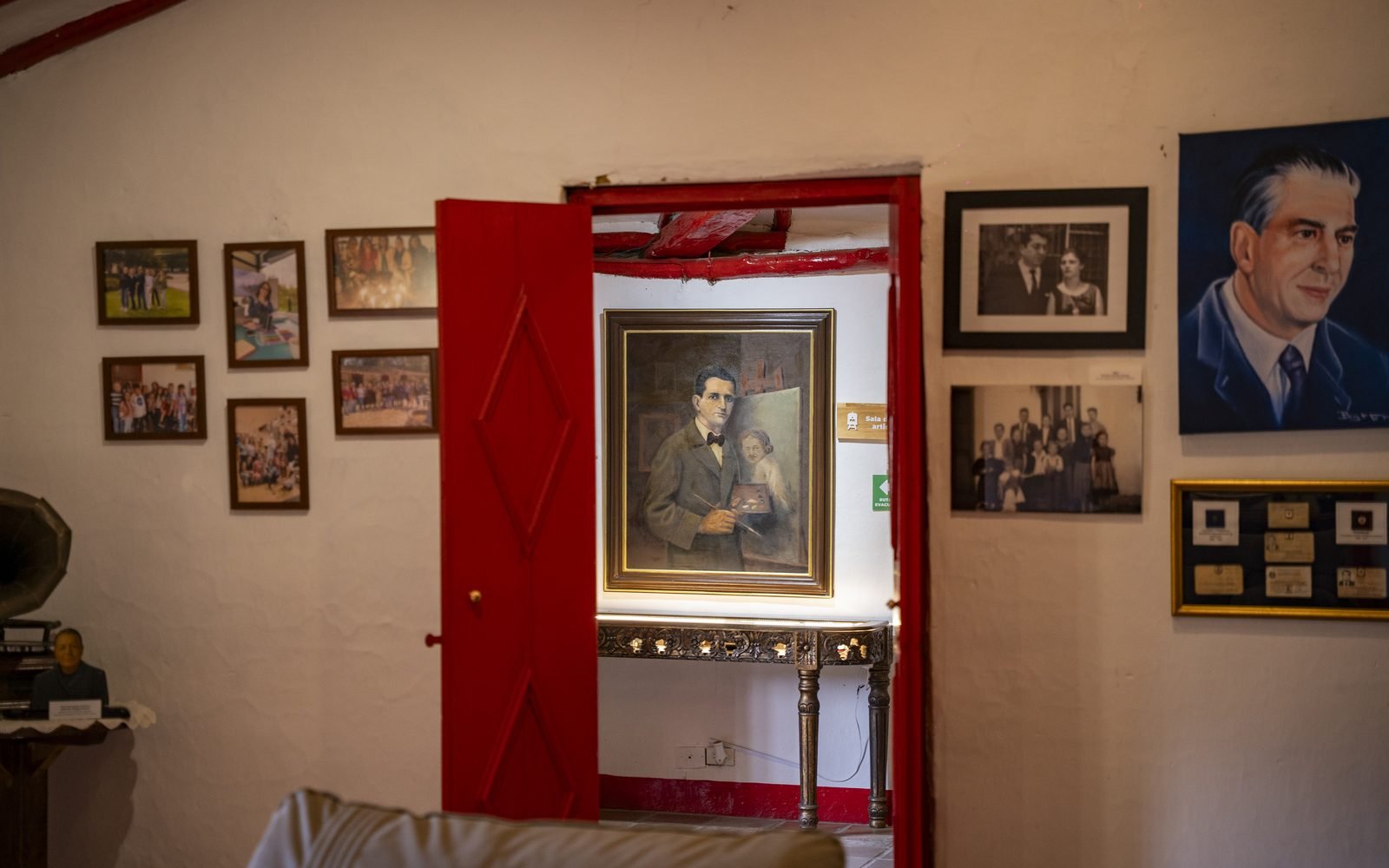
Salón de los artistasThe Artists’ Room
Creatividad como patrimonioCreativity as heritage
Audio en preparación. Las grabaciones de esta sala van en audio/es/07-salon-artistas/ y el reproductor se activa solo.
Recording in preparation. This room’s files go in audio/en/07-salon-artistas/ and the player activates automatically.
El arte también hace parte de nuestra memoria.
Este espacio reúne a algunos de los artistas santuarianos que, a través de la fotografía, la pintura, la escultura, la música y las nuevas formas de comunicación, dejaron una huella en la historia de nuestro municipio.
Más que conservar sus obras y objetos, queremos reconocer en ellos una posibilidad: la creatividad como una forma de expresión, de trabajo y de vida.
Art is also part of our memory.
This space brings together some of the artists of El Santuario who, through photography, painting, sculpture, music and the new forms of communication, left their mark on the history of our municipality.
More than preserving their works and objects, we want to recognise in them a possibility: creativity as a form of expression, of work and of life.
Leer el guion completo de la salaRead the full room script
El arte también es parte de nuestra memoria. Esta sala reúne a algunos santuarianos que, con la fotografía, la pintura, la escultura y la música, dejaron huella en el pueblo. Además de obras, dejaron oficios, conocimientos y caminos abiertos para quienes vinieron después. Lo que queremos conservar aquí para las nuevas generaciones es algo muy nuestro: la capacidad de crear.
Empezamos con uno de los personajes más versátiles que ha tenido El Santuario, Floro Ezequiel Zuluaga, que vivió entre 1898 y 1978. Si ha recorrido la casa, ya lo conoce. Sus fotografías están en casi todas las salas. Pero Floro fue también pintor y escultor: pintó el primer escudo del pueblo, instaló la primera planta de energía y trajo la radio y el cine a El Santuario. Su historia muestra que la creatividad no siempre cabe en una sola disciplina.
Seguimos con Jesús Antonio Botero, a quien los santuarianos llamaban con cariño «Boterito», el mismo don Antonio Botero que retrató tantas bodas, familias y despedidas de esta casa. Entre 1945 y 1975 tuvo su taller, «Foto Arte», y conservó el archivo fotográfico más grande de El Santuario. Gracias a él podemos hoy reconocer rostros, lugares y momentos que de otra manera se habrían perdido.
Después vino Jesús Antonio Giraldo, «Toñito el fotógrafo». En 1968 trajo la fotografía a color a El Santuario y, desde los años 70 hasta comienzos de los 2000, fue uno de los fotógrafos más importantes del pueblo. Con Floro, Boterito y Toñito, la memoria de El Santuario pasó del blanco y negro al color, de una generación de fotógrafos a otra.
Y llegamos a la música. Roberto Pineda Duque, a quien quizá vio con su familia en La Sala, es el músico más importante que ha dado El Santuario. Empezó a los 12 años en el coro de la parroquia y llegó a ser uno de los grandes compositores de Colombia. Dirigió la Orquesta Sinfónica de Colombia y compuso la música del himno de Bogotá. Su historia nos recuerda que el talento que nace en un pueblo puede llegar muy lejos.
Terminamos con un instrumento que une la música y la educación. Este armonio, fabricado en Alemania, llegó en 1922 con las hermanas salesianas, que lo trajeron desde Italia cuando asumieron el Colegio La Inmaculada, que luego se convertiría en el Colegio María Auxiliadora. Cruzó el océano para acompañar a varias generaciones de santuarianas.
Art is also part of our memory. This room brings together some people from El Santuario who left their mark on the town through photography, painting, sculpture and music. Beyond their works, they left trades, knowledge and paths opened for those who came after them. What we want to preserve here for new generations is something very much our own: the capacity to create.
We begin with one of the most versatile figures El Santuario has known, Floro Ezequiel Zuluaga, who lived from 1898 to 1978. If you have walked through the house, you already know him. His photographs are in almost every room. But Floro was also a painter and sculptor: he painted the town’s first coat of arms, installed its first power plant and brought radio and cinema to El Santuario. His story shows that creativity does not always fit within a single discipline.
We continue with Jesús Antonio Botero, whom the people of El Santuario affectionately called “Boterito”, the same don Antonio Botero who photographed so many of the weddings, families and farewells in this house. From 1945 to 1975 he ran his studio, “Foto Arte”, and he kept the largest photographic archive in El Santuario. Thanks to him, today we can recognise faces, places and moments that would otherwise have been lost.
Then came Jesús Antonio Giraldo, “Toñito the photographer”. In 1968 he brought colour photography to El Santuario, and from the 1970s to the early 2000s he was one of the most important photographers in town. With Floro, Boterito and Toñito, the memory of El Santuario passed from black and white to colour, from one generation of photographers to the next.
And now we come to music. Roberto Pineda Duque, whom you may have seen with his family in La Sala, the living room, is the most important musician El Santuario has produced. He started at the age of 12 in the parish choir and went on to become one of Colombia’s great composers. He conducted the Orquesta Sinfónica de Colombia and composed the music of the anthem of Bogotá. His story reminds us that talent born in a small town can go a very long way.
We end with an instrument that brings music and education together. This harmonium, made in Germany, arrived in 1922 with the Salesian Sisters, who brought it from Italy when they took charge of the Colegio La Inmaculada, which would later become the Colegio María Auxiliadora. It crossed the ocean to accompany several generations of girls and young women from El Santuario.
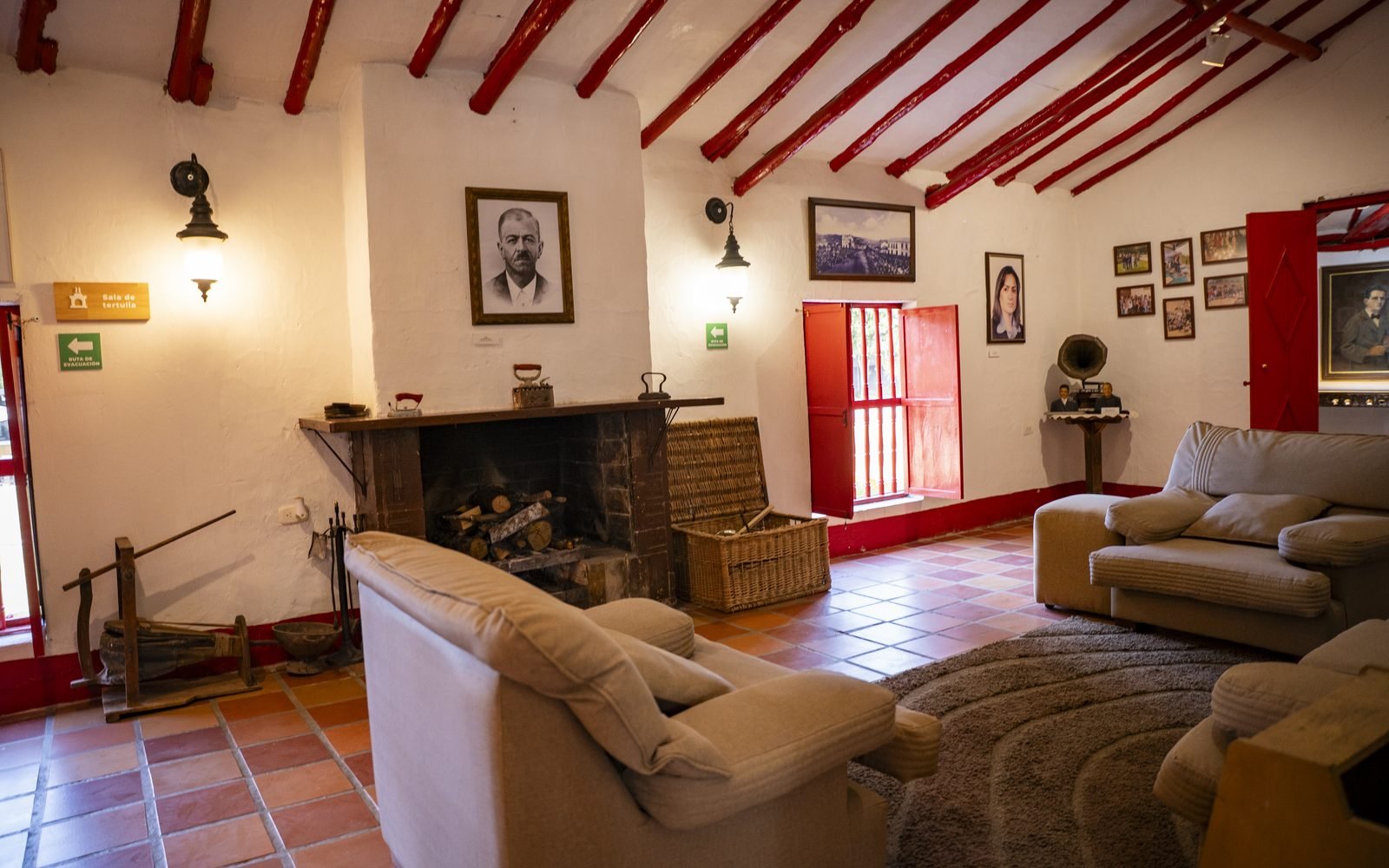
Sala de TertuliaThe Conversation Room
Historias, personajes y recuerdosStories, characters and memories
Audio en preparación. Las grabaciones de esta sala van en audio/es/08-sala-tertulia/ y el reproductor se activa solo.
Recording in preparation. This room’s files go in audio/en/08-sala-tertulia/ and the player activates automatically.
Esta sala reúne algunas historias, imágenes y personajes que hacen parte de la memoria de El Santuario.
Aquí encontramos fotografías que muestran cómo ha cambiado nuestro pueblo, objetos que hablan de su historia y personas que, con sus palabras, sus acciones y sus recuerdos, dejaron una huella en la comunidad.
Es también un espacio para recordar una tradición que ha acompañado a muchas generaciones: la tertulia, ese momento de reunirse para conversar, escuchar historias, compartir recuerdos y pasar el tiempo juntos.
This room gathers stories, images and characters that are part of the memory of El Santuario.
Here we find photographs showing how our town has changed, objects that speak of its history, and people who left a mark on the community through their words, their actions and their memories.
It is also a place to remember a tradition that has accompanied many generations: the tertulia, that moment of coming together to talk, listen to stories, share memories and simply spend time with one another.
Leer el guion completo de la salaRead the full room script
Esta sala está dedicada a las historias, los personajes y los recuerdos de El Santuario, y a una tradición que ha acompañado a muchas generaciones. La tertulia es el rato de reunirse a conversar, contar historias y compartir recuerdos. Le sugerimos recorrerla de izquierda a derecha.
Comenzamos con las fotografías panorámicas del pueblo. En ellas puede ver cómo ha cambiado El Santuario con los años. El paisaje, las casas y las calles se transforman, pero las fotografías conservan lo que alguna vez estuvo aquí.
Más adelante hay dos piezas que nos llevan a momentos importantes de nuestra historia. La primera es el primer escudo de El Santuario, encargado en 1932 por la Sociedad de Mejoras Públicas y pintado por Floro Ezequiel Zuluaga, a quien ha encontrado en otras salas. El escudo rinde homenaje sobre todo a José María Córdova, el héroe de Ayacucho, que murió en El Santuario en 1829.
A su lado hay una bayoneta de hacia 1864. Nos recuerda los años de las guerras entre liberales y conservadores y de las persecuciones religiosas que marcaron al país en el siglo XIX. Aquí mismo, en la vereda Aldana, el obispo Valerio Antonio Jiménez tuvo que esconderse en 1879, en una roca que desde entonces se llama la Piedra del Obispo.
Y llegamos a uno de los personajes más queridos de esta sala, Ramoncito Zuluaga. A comienzos del siglo XX fue comerciante de telas, arriero y tinturador de cabuya. Pero lo que lo hizo inolvidable fue su amor por las historias.
Le gustaba reunirse con los niños en la plaza y contarles relatos inventados por él, y cuando llegaba la parte más emocionante se detenía: «Mañana le sigo». Al día siguiente, ahí estaban los niños otra vez, esperando saber qué había pasado. Ellos mismos le pusieron el nombre con el que se le recuerda: el Palabrero Mayor. Pocas cosas explican mejor lo que es una tertulia: la palabra como una manera de reunirnos y de mantener viva una historia.
Seguimos hacia la pared de los fundadores, donde se cuenta la historia de este lugar. La Fundación Aurum lleva ese nombre en honor a doña Aura Margarita Gómez Aristizábal, esposa de don Jaime Zuluaga Ramírez. Aurum es la palabra latina para el oro, y de ella viene su símbolo, Au, las mismas letras con que empieza el nombre de doña Aura. A esa palabra se le asoció también el brillo del amanecer, la luz con que empieza algo nuevo.
En 2019 se compró el terreno donde hoy funciona la Fundación. En 2020, sus fundadores, don Jaime Zuluaga Ramírez, su hijo Jaime Augusto Zuluaga y su esposa Yulady Giraldo, junto con Ángela Zuluaga y Luz Elena Arango, definieron su propósito y sus tres áreas de trabajo: la educación, la memoria y la cultura, y el bienestar. Luz Elena Arango fue una mujer inteligente y práctica que ayudó a construir lo que hoy es la Fundación Aurum y quien impulsó los grupos de lectura para mujeres, niños y jóvenes. Ya no está con nosotros, pero la recordamos con mucho cariño.
Ese mismo año empezó la adecuación de esta casa como museo, a cargo de Omar Botero y Yolima Gómez, fundadores de la Casa Museo de El Santuario. Muchos de los objetos que ha visto en este recorrido están aquí gracias a ellos. También en 2020 se dictaron los primeros talleres de confección.
En 2021 se inauguró el Salón de Vidrio y comenzaron los grupos de lectura. Después llegaron los programas para niños, jóvenes y padres, y los Viernes Culturales en esta casa. En 2025 se construyó el puente de La Chapa, y en 2026 se abrió por allí la entrada principal.
Hoy la Fundación trabaja en tres frentes: la Academia de Tecnologías para la Confección, el Centro de Servicios Educativos y el área de memoria y cultura, a la que pertenece este museo. Esta pared es, sobre todo, un gesto de gratitud con quienes hicieron posible este sueño.
Terminamos en esta esquina con las fotografías de Gilberto Salazar Ramírez, el antiguo dueño de esta casa. Fue un hombre cívico, de los que trabajaron por el progreso del pueblo. Dirigió la revista El Santuariano, la misma que fundaron el maestro Eusebio María Gómez y su hijo Filemón.
Y a él se debe que Cornare, la Corporación Ambiental del Oriente Antioqueño, tenga su sede aquí. Cuando se creó, en 1983, Gilberto presidía su consejo directivo y propuso a El Santuario, su pueblo. Un estudio técnico confirmó que era el punto más central entre los 26 municipios de la región, y la propuesta se aprobó por unanimidad. Es justo que la casa que fue suya guarde hoy la memoria de todo el pueblo.
PANORÁMICA DEL PUEBLO · 1895
Esta es la fotografía más antigua de la que se tenga noticia de El Santuario. Fue captada por el lente del prestigioso fotógrafo Melitón Rodríguez en 1895. Fue tomada desde la parte más alta del sector de Cristo Rey; es decir, de la esquina de Luis Ángel Giraldo hacia arriba.
La importancia histórica de esta foto radica en el hecho de que nos permite hacernos una idea muy precisa del proceso arquitectónico del pueblo y nos remite a una época en que un pueblo que, hasta ese entonces, era netamente rural comienza a mirar, con timidez pero con decisión, el desarrollo de la urbe.
PANORÁMICA DEL PARQUE · 1915
Esta hermosa fotografía posee un gran valor histórico, pues capta la celebración de los 150 años de la primera eucaristía que se celebró en suelo santuariano, en diciembre de 1765. Para representar tan importante acontecimiento se construyó, de manera alegórica y en materiales sencillos, una pequeña capilla que emulaba la primera, construida por Antonio Gómez de Castro.
El lente de Francisco Moreno Ramírez capta, desde la colina occidental del pueblo (actual Calvario), el momento justo de la elevación y consagración eucarística, mientras el pueblo, postrado de rodillas, contempla el sublime acontecimiento.
CASA DEL PADRE PABLO TULIO PINEDA · 1915
Fotografía que capta parte de la actual calle del Comercio, a la altura del puente del Colegio María Auxiliadora. En ese entonces, esa antigua casona pertenecía al padre Pablo Tulio Pineda Gómez, quien en 1918 la donó para que en ella vinieran a trabajar las hermanas salesianas. La fotografía fue tomada por Francisco Moreno Ramírez.
INAUGURACIÓN DE LA CARRETERA · 1925
Fotografía tomada desde la casa de Luis Azarías por el artista santuariano Floro Ezequiel Zuluaga, el viernes 25 de diciembre de 1925, cuando más de 14 carros llegaron al parque principal después de recorrer la recién construida carretera El Santuario–Marinilla. Fue un acontecimiento inédito en la historia de nuestro municipio, que por primera vez veía abrirse sendas de progreso y bienestar. El pueblo entero salió en masa para ser testigo de excepción de tan importante acontecimiento.
SALIDA DE LOS CARROS HACIA MARINILLA · 1925
Fotografía tomada por Floro Ezequiel Zuluaga desde uno de los barrancos de la salida hacia Marinilla, la tarde del viernes 25 de diciembre de 1925, en el momento en que los carros que vinieron a solemnizar la inauguración de la carretera salen de nuevo para Marinilla y Rionegro. El mayor valor de esta fotografía radica en que fue la primera vez que el pueblo se fotografió desde un ángulo poco convencional, lo que nos permite apreciar una visión más amplia del contexto urbano de El Santuario en los años 20.
PANORÁMICA DE EL SANTUARIO · 1929
Panorámica que fue tomada en mayo de 1929. En ella se observa el avance urbanístico del pueblo durante la década del 20. Se aprecia el avance de la construcción de la basílica de San Judas y los avances de la carretera hacia Cocorná, por la zona del Corazón de Jesús.
Exactamente, fue tomada el jueves 9 de mayo de dicho año, día de la Ascensión. Se aprovechó esta festividad para recoger fondos para la construcción del templo de San Judas. En el atrio se logra percibir la imagen de San Judas Tadeo y a un grupo de personas alrededor de ella. El Santuariano se refirió a dicha ofrenda de la siguiente manera: «El 9 del presente mayo tuvo lugar una ofrenda para el templo de San Judas y, a pesar del poco concurso de la gente, se recaudaron más de ochocientos pesos». Fotografía de Floro Ezequiel Zuluaga.
PANORÁMICA DE EL SANTUARIO · 1935
Fotografía correspondiente al mes de agosto de 1935, con motivo de la inauguración del templo de San Judas Tadeo. Es probablemente una de las imágenes más bellas que se han tomado de nuestro pueblo, no solo por su antigüedad, sino por ser la primera en la que las dos iglesias aparecen alineadas. Fotografía de Floro Ezequiel Zuluaga.
PANORÁMICA DEL PARQUE · 1945
Fotografía del artista santuariano Luis Eduardo Ramírez, que capta los elementos ornamentales más importantes del parque principal en la década de los 40. En primer plano aparecen unos pinos que durante muchos años bordearon todo el parque, hasta 1952, cuando fueron talados para pavimentar el parque.
Sobresale también el emblemático kiosco, construido en 1938. Llama poderosamente la atención una estación de gasolina que hay en uno de los costados del kiosco, perteneciente a don Pedro Luis Duque. La parte central del parque estaba profusamente arborizada y tenía la estructura que básicamente se conservó hasta 2009.
PANORÁMICA DEL PARQUE · 1962
Esta bella fotografía fue tomada desde el balcón de la casa de don Julio Giraldo por el acreditado fotógrafo antioqueño Gabriel Carvajal, en una tarde de mercado dominical. En ella se hace evidente la dinámica comercial de productos agrícolas, panela y carnes que se vendían en los famosos toldos. Es también notoria la gran cantidad de carros de todos los estilos y modelos, lo que denota el inmenso dinamismo económico que caracterizó a El Santuario a inicios de los años 60.
This room is dedicated to the stories, characters and memories of El Santuario, and to a tradition that has accompanied many generations. The tertulia is the time spent getting together to talk, tell stories and share memories. We suggest you walk through it from left to right.
We begin with the panoramic photographs of the town. In them you can see how El Santuario has changed over the years. The landscape, the houses and the streets change, but the photographs keep what was once here.
Further on are two pieces that take us back to important moments in our history. The first is the first coat of arms of El Santuario, commissioned in 1932 by the Sociedad de Mejoras Públicas and painted by Floro Ezequiel Zuluaga, whom you have met in other rooms. Above all, the coat of arms pays tribute to José María Córdova, the hero of Ayacucho, who died in El Santuario in 1829.
Next to it is a bayonet from around 1864. It recalls the years of the wars between Liberals and Conservatives and of the religious persecutions that marked the country in the nineteenth century. Right here, in the rural district of Aldana, Bishop Valerio Antonio Jiménez had to hide in 1879, in a rock that has been known ever since as the Piedra del Obispo, the Bishop’s Stone.
And now we come to one of the best-loved figures in this room, Ramoncito Zuluaga. In the early twentieth century he was a cloth merchant, a muleteer and a dyer of fique fibre. But what made him unforgettable was his love of stories.
He liked to gather the children in the square and tell them tales he had made up himself, and when he reached the most exciting part he would stop: “I’ll carry on tomorrow.” The next day, there the children were again, waiting to find out what had happened. They themselves gave him the name by which he is remembered: the Palabrero Mayor, the Master of Words. Few things explain better what a tertulia is: the spoken word as a way of coming together and keeping a story alive.
We continue towards the founders’ wall, which tells the story of this place. The Fundación Aurum is named in honour of doña Aura Margarita Gómez Aristizábal, wife of don Jaime Zuluaga Ramírez. Aurum is the Latin word for gold, and from it comes its symbol, Au, the same letters that begin doña Aura’s name. The word was also associated with the glow of dawn, the light with which something new begins.
In 2019 the land where the Fundación operates today was bought. In 2020 its founders, don Jaime Zuluaga Ramírez, his son Jaime Augusto Zuluaga and his wife Yulady Giraldo, together with Ángela Zuluaga and Luz Elena Arango, defined its purpose and its three areas of work: education, memory and culture, and well-being. Luz Elena Arango was an intelligent, practical woman who helped build what the Fundación Aurum is today and who championed the reading groups for women, children and young people. She is no longer with us, but we remember her with great affection.
That same year work began on adapting this house as a museum, led by Omar Botero and Yolima Gómez, founders of the Casa Museo de El Santuario. Many of the objects you have seen on this tour are here thanks to them. Also in 2020, the first garment-making workshops were held.
In 2021 the Salón de Vidrio was inaugurated and the reading groups began. Then came the programmes for children, young people and parents, and the Viernes Culturales, cultural Fridays, in this house. In 2025 the La Chapa bridge was built, and in 2026 the main entrance was opened there.
Today the Fundación works on three fronts: the Academia de Tecnologías para la Confección, the Centro de Servicios Educativos and the area of memory and culture to which this museum belongs. Above all, this wall is a gesture of gratitude to those who made this dream possible.
We finish in this corner with the photographs of Gilberto Salazar Ramírez, the former owner of this house. He was a civic-minded man, one of those who worked for the progress of the town. He directed the magazine El Santuariano, the same one founded by the teacher Eusebio María Gómez and his son Filemón.
And it is thanks to him that Cornare, the Corporación Ambiental del Oriente Antioqueño, has its headquarters here. When it was created, in 1983, Gilberto chaired its board of directors and proposed El Santuario, his home town. A technical study confirmed that it was the most central point among the region’s 26 municipalities, and the proposal was approved unanimously. It is only fitting that the house that was his should today keep the memory of the whole town.
PANORAMIC VIEW OF THE TOWN · 1895
This is the oldest known photograph of El Santuario. It was captured through the lens of the renowned photographer Melitón Rodríguez in 1895. It was taken from the highest part of the Cristo Rey area, that is, from Luis Ángel Giraldo’s corner upwards.
Its historical importance lies in the fact that it gives us a very precise idea of how the town was built, and takes us back to a time when a town that had until then been entirely rural was beginning, shyly but resolutely, to look towards urban development.
PANORAMIC VIEW OF THE PARK · 1915
This beautiful photograph has great historical value, as it captures the celebration of the 150th anniversary of the first Mass held on the soil of El Santuario, in December 1765. To mark such an important event, a small chapel was built, symbolically and from simple materials, in imitation of the first one, built by Antonio Gómez de Castro.
From the western hill above the town (today’s Calvario), Francisco Moreno Ramírez’s lens captures the very moment of the elevation and consecration, while the people, on their knees, contemplate this sublime event.
FATHER PABLO TULIO PINEDA’S HOUSE · 1915
A photograph showing part of today’s Calle del Comercio, near the bridge by the Colegio María Auxiliadora. At the time, this large old house belonged to Father Pablo Tulio Pineda Gómez, who in 1918 donated it so that the Salesian Sisters could come and work in it. The photograph was taken by Francisco Moreno Ramírez.
OPENING OF THE ROAD · 1925
A photograph taken from Luis Azarías’s house by the El Santuario artist Floro Ezequiel Zuluaga on Friday 25 December 1925, when more than 14 cars arrived in the main square after travelling the newly built road from El Santuario to Marinilla. It was an unprecedented event in the history of our municipality, which for the first time saw paths to progress and well-being opening up. The whole town turned out en masse to bear witness to such an important occasion.
CARS LEAVING FOR MARINILLA · 1925
A photograph taken by Floro Ezequiel Zuluaga from one of the banks along the road out to Marinilla, on the afternoon of Friday 25 December 1925, as the cars that had come to celebrate the opening of the road set off again for Marinilla and Rionegro. Its greatest value lies in the fact that it was the first time the town was photographed from such an unusual angle, which gives us a broader view of El Santuario’s urban setting in the 1920s.
PANORAMIC VIEW OF EL SANTUARIO · 1929
This panorama was taken in May 1929. It shows the town’s urban growth during the 1920s. You can see the progress in building the basilica of San Judas and the advance of the road towards Cocorná, through the Corazón de Jesús area.
To be exact, it was taken on Thursday 9 May that year, Ascension Day. The feast was used to raise funds for building the church of San Judas. In the atrium you can make out the image of Saint Jude Thaddeus and a group of people around it. El Santuariano described the offering as follows: “On the 9th of this May an offering was held for the church of San Judas and, despite the poor turnout, more than eight hundred pesos were collected.” Photograph by Floro Ezequiel Zuluaga.
PANORAMIC VIEW OF EL SANTUARIO · 1935
A photograph from August 1935, taken on the occasion of the inauguration of the church of San Judas Tadeo. It is probably one of the most beautiful images ever taken of our town, not only for its age but because it is the first in which the two churches appear in line. Photograph by Floro Ezequiel Zuluaga.
PANORAMIC VIEW OF THE PARK · 1945
A photograph by the El Santuario artist Luis Eduardo Ramírez, capturing the most important ornamental features of the main square in the 1940s. In the foreground are some pine trees that for many years lined the whole park, until 1952, when they were cut down so the park could be paved.
The emblematic kiosk, built in 1938, also stands out. Most striking of all is a petrol station on one side of the kiosk, which belonged to don Pedro Luis Duque. The centre of the park was thickly planted with trees and had the layout that was essentially kept until 2009.
PANORAMIC VIEW OF THE PARK · 1962
This fine photograph was taken from the balcony of don Julio Giraldo’s house by the well-known Antioquian photographer Gabriel Carvajal, on a Sunday market afternoon. It clearly shows the bustle of trade in farm produce, panela and meat sold from the famous market stalls. Also striking is the large number of cars of every style and model, a sign of the tremendous economic energy that marked El Santuario in the early 1960s.
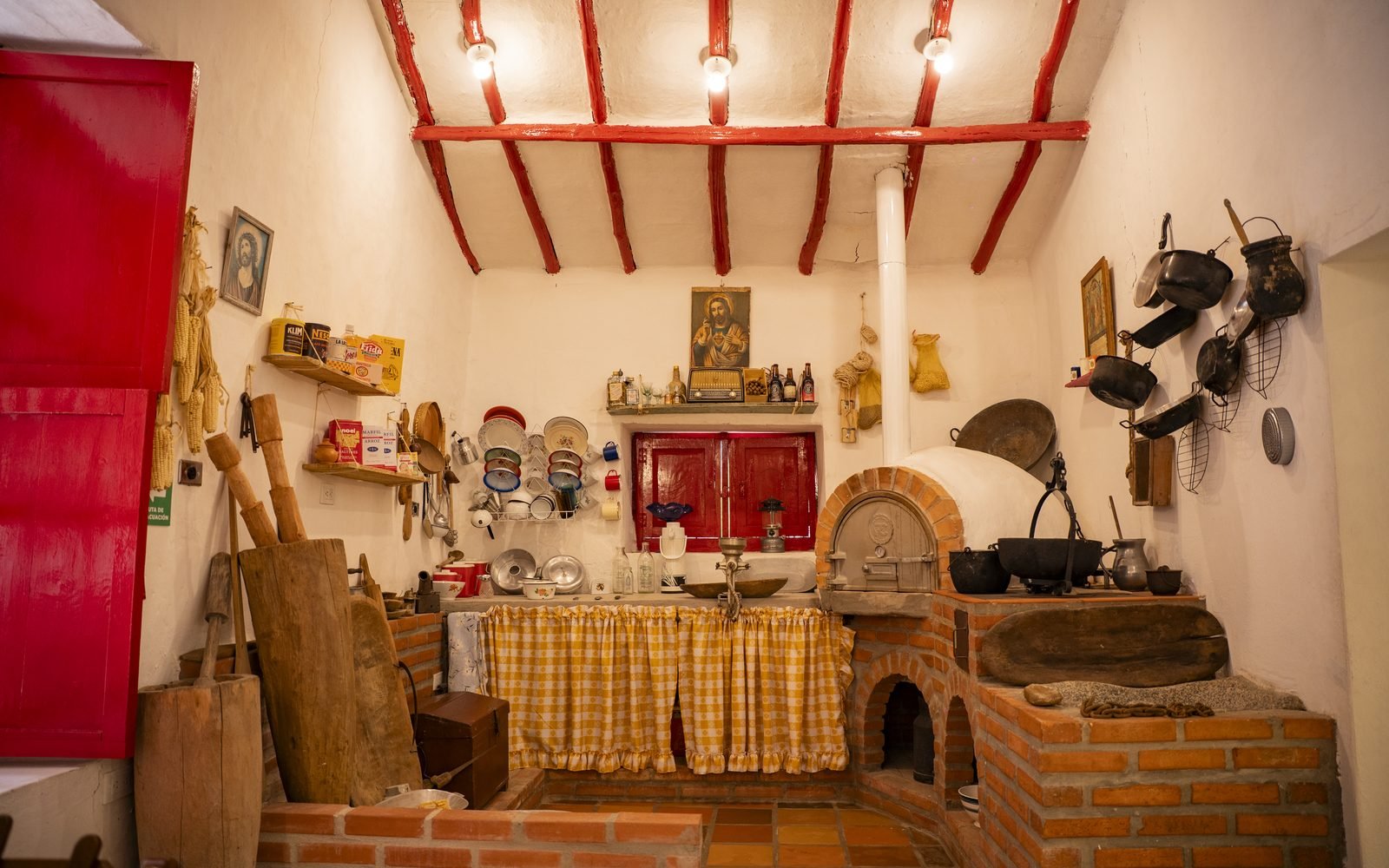
Cocina CampesinaThe Country Kitchen
Homenaje al campesino santuarianoA tribute to the campesino
Audio en preparación. Las grabaciones de esta sala van en audio/es/09-cocina-campesina/ y el reproductor se activa solo.
Recording in preparation. This room’s files go in audio/en/09-cocina-campesina/ and the player activates automatically.
La cocina campesina es un homenaje a nuestros campesinos, alma y nervio de la sociedad santuariana.
Este espacio evoca las cocinas de antaño, donde el fogón era mucho más que un lugar para preparar los alimentos: era un punto de encuentro para la familia, las historias y los saberes que pasaban de una generación a otra.
El pilón, la piedra de moler, las bateas y demás utensilios nos acercan a una forma de vida en la que las manos, la tierra y el ingenio eran protagonistas.
Una invitación a recordar nuestras raíces y reconocer en ellas parte de lo que somos como santuarianos.
The country kitchen is a tribute to our campesinos, the soul and sinew of life in El Santuario.
This space evokes the kitchens of times past, where the hearth was far more than a place to cook: it was a meeting point for the family, for stories and for knowledge passed from one generation to the next.
The pilón, the grinding stone, the wooden basins and the other utensils bring us close to a way of life in which hands, land and ingenuity were the protagonists.
An invitation to remember our roots and to recognise in them part of who we are.
Leer el guion completo de la salaRead the full room script
Bienvenidos a la Cocina Campesina, un homenaje a nuestros campesinos, alma y nervio de la sociedad santuariana. Cuando pensamos en una cocina campesina, pensamos en mucho más que un lugar para preparar alimentos. Pensamos en el fogón encendido, en el trabajo de las manos, en los productos de la tierra y en la familia reunida alrededor de la mesa.
Durante generaciones, la cocina fue también una escuela. Allí se aprendían recetas y maneras de cultivar, pero también historias, costumbres y formas de vivir.
Por eso, en esta sala recreamos algunos elementos de las cocinas de antes: el fogón de leña, donde se cocinaba y donde la familia se sentaba a calentarse y a conversar; el pilón, donde se golpeaba el maíz para quitarle la cáscara; la piedra de moler, donde se molía ese maíz para hacer la masa de las arepas, y las bateas de madera, donde se lavaban los granos y se amasaba. Objetos sencillos, pero llenos de significado.
De cocinas como estas salieron también las recetas que todavía nos identifican, como el buñuelo santuariano de maíz y cuajada del que le hablamos en La Sala. Gran parte de lo que somos como santuarianos tiene sus raíces en la vida del campo, en el trabajo de la tierra y en los saberes que nuestros campesinos han guardado y transmitido.
Para despedirnos de esta sala, le dejamos un poema de Diana Gutiérrez dedicado a quien era el corazón de estas cocinas: la madre.
El audio termina con la lectura de ese poema de Diana Gutiérrez.
Welcome to the Country Kitchen, a tribute to our campesinos, the soul and sinew of life in El Santuario. When we think of a country kitchen, we think of much more than a place to prepare food. We think of the lit hearth, of work done by hand, of the fruits of the land and of the family gathered around the table.
For generations, the kitchen was also a school. Recipes and ways of growing crops were learnt there, but also stories, customs and ways of living.
That is why in this room we have recreated some of the elements of the kitchens of the past: the wood-fired hearth, where food was cooked and where the family sat to warm themselves and talk; the pilón (a wooden mortar), where maize was pounded to remove its hull; the grinding stone, where that maize was ground to make the dough for arepas; and the wooden basins, where grain was washed and dough was kneaded. Simple objects, but full of meaning.
Kitchens like these also gave us the recipes that still define us, such as the buñuelo santuariano, made with maize and cuajada curd cheese, that we told you about in La Sala, the living room. Much of who we are as people of El Santuario is rooted in country life, in working the land and in the knowledge our campesinos have kept and passed down.
To say goodbye to this room, we leave you with a poem by Diana Gutiérrez dedicated to the one who was the heart of these kitchens: the mother.
The audio ends with a reading of that poem by Diana Gutiérrez.
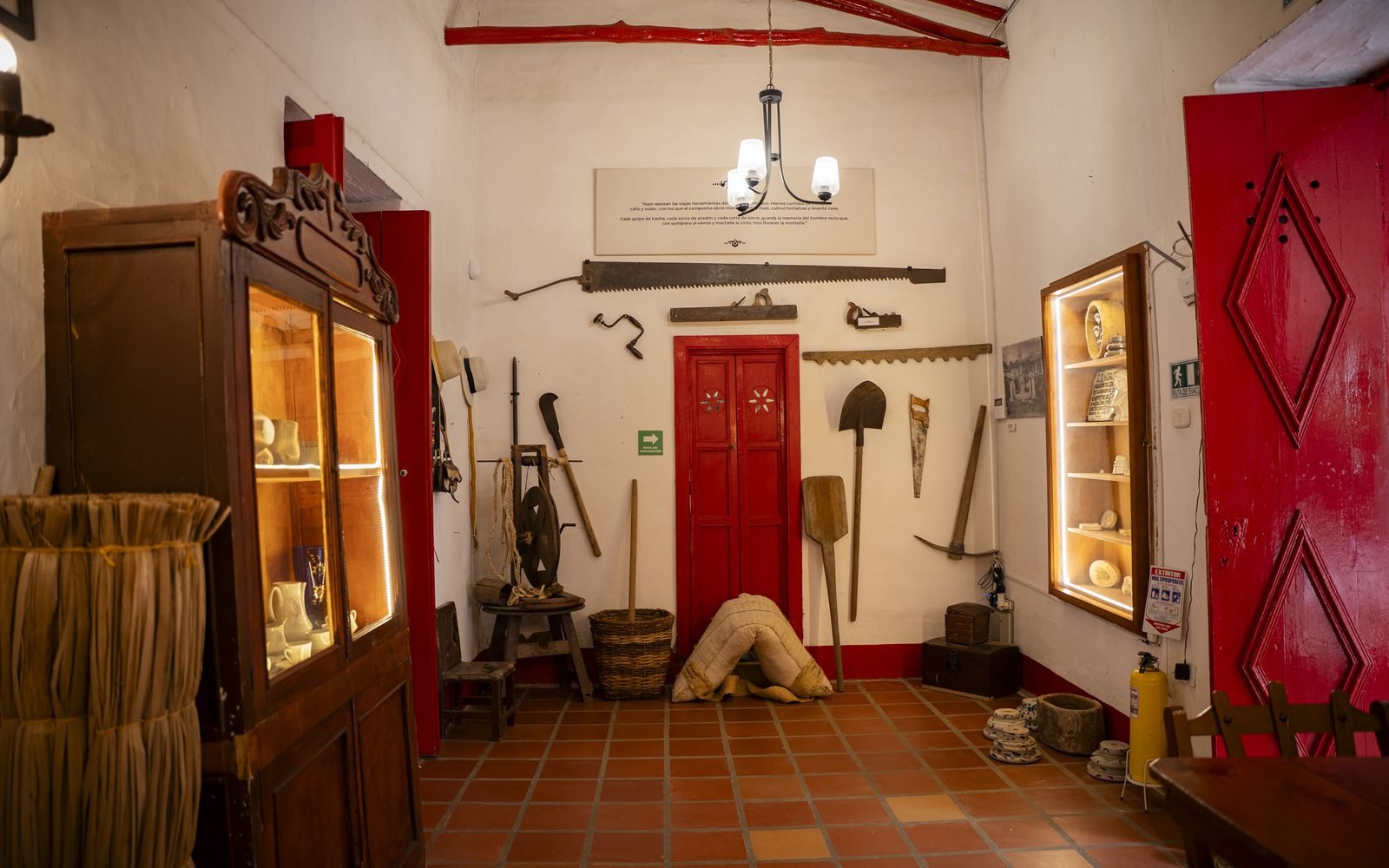
Espacio en honor a la cerámicaIn Honour of Ceramics
La Cerámica de El SaltoCerámica de El Salto
Audio en preparación. Las grabaciones de esta sala van en audio/es/10-ceramica/ y el reproductor se activa solo.
Recording in preparation. This room’s files go in audio/en/10-ceramica/ and the player activates automatically.
La tierra también cuenta nuestra historia.The earth also tells our history.
En este espacio rendimos homenaje a la tradición ceramista de El Santuario y, especialmente, a la Cerámica de El Salto, una de las primeras fábricas de cerámica establecidas en Colombia.
Desde finales del siglo XIX, el barro se convirtió en materia prima para crear objetos de uso cotidiano, piezas religiosas y elementos que hicieron parte de la vida de muchas generaciones.
Hoy, los restos de sus antiguos hornos permanecen en El Salto como testigos de una historia que hace parte de nuestra memoria industrial y cultural.
This space pays tribute to the ceramic tradition of El Santuario and, above all, to Cerámica de El Salto, one of the first ceramic factories established in Colombia.
From the late nineteenth century, clay became the raw material for everyday objects, religious pieces and elements that were part of the lives of many generations.
Today the remains of its old kilns still stand in El Salto as witnesses to a history that belongs to our industrial and cultural memory.
Leer el guion completo de la salaRead the full room script
La tierra también cuenta nuestra historia. Este espacio rinde homenaje a la tradición ceramista de El Santuario y, sobre todo, a la Cerámica de El Salto, la primera fábrica de porcelana dura del país.
Su historia empezó hacia 1880. En la vereda de El Salto la fundaron el general Eusebio María Gómez, padre del maestro que da nombre a la escuela de varones, y el comerciante Lisandro Zuluaga, que había aprendido el oficio de la porcelana en Mompox, en la costa Caribe. Aprovecharon las tres caídas de agua del lugar para mover los molinos y levantaron hornos de adobe con altas chimeneas.
De allí salieron piezas muy distintas: aisladores de porcelana para las primeras redes eléctricas, baldosas, lápidas como las que vio en el cementerio, inodoros, pilastras, pasamanos, vajillas e imágenes religiosas. Sus baldosas llegaron a la catedral de Rionegro y a las iglesias de Abejorral y Concepción, y su primera gran venta fue para el piso de nuestra propia iglesia principal, instalado en 1909.
Todavía se pueden ver allí las baldosas con la frase en latín «Esta es la casa de Dios». Así que la cerámica no era solo un oficio artesanal: fue parte de la construcción, de la llegada de la electricidad y de la economía de toda la región.
Como muchas industrias, la fábrica fue enfrentando dificultades: los productos importados le quitaron mercado y la producción fue disminuyendo hasta que cerró en los años 80. Pero su historia sigue en pie.
En El Salto, en medio del bosque, todavía se conservan los restos de sus antiguos hornos. Frente a ellos es fácil imaginar la fábrica en marcha: el ruido del agua, el calor del fuego, los trabajadores dando forma al barro y una industria que, durante un siglo, fue parte de la vida de El Santuario.
LA FUENTE DEL PARQUE · 1913
En diciembre de 1913, El Santuario inauguró la fuente de su parque principal. Con ella se quiso dejar memoria del primer Congreso Eucarístico celebrado en Colombia, en septiembre de ese mismo año.
La fuente se hizo aquí, en la Cerámica de El Salto: cada baldosa y cada pilastra se moldeó, se horneó y se esmaltó en sus hornos. La asesoría artística fue de Francisco Moreno Ramírez, autor de las cuatro figuras de la pilastra principal: hacia el oriente, Antonio Gómez de Castro; hacia el norte, el general Eusebio María Gómez Duque; hacia el occidente, José Ignacio Botero Palacio, y hacia el sur, el coronel Anselmo Pineda Gómez. Ezequiel Hoyos armó todas las piezas en el parque e instaló las tuberías para la entrada y la salida del agua.
La fotografía también es de Francisco Moreno Ramírez, que además era fotógrafo. Una multitud acompañó la inauguración. A la izquierda, mirando a la cámara, con sombrero de fieltro y corbatín negro, está Germán Zuluaga Gómez, y a su lado, igual de elegante, su hermano José María, «Chepito». A la derecha aparece don Ezequiel Hoyos, que todavía tiene en las manos el palustre y una de las últimas piezas de cerámica.
The earth, too, tells our story. This space pays tribute to the ceramic tradition of El Santuario and, above all, to the Cerámica de El Salto, the first hard-paste porcelain factory in the country.
Its story began around 1880. In the rural district of El Salto it was founded by General Eusebio María Gómez, father of the teacher after whom the boys’ school is named, and by the merchant Lisandro Zuluaga, who had learnt the porcelain trade in Mompox, on the Caribbean coast. They harnessed the three waterfalls on the site to drive the mills and built adobe kilns with tall chimneys.
Very different pieces came out of it: porcelain insulators for the first electricity networks, floor tiles, gravestones like the ones you saw in the cemetery, toilets, pilasters, handrails, tableware and religious images. Its tiles reached Rionegro Cathedral and the churches of Abejorral and Concepción, and its first big sale was for the floor of our own main church, laid in 1909.
The tiles bearing the Latin phrase “This is the house of God” can still be seen there. So ceramics were not just a craft: they were part of construction, of the arrival of electricity and of the economy of the whole region.
Like many industries, the factory faced mounting difficulties: imported products took away its market and production gradually declined until it closed in the 1980s. But its story still stands.
In El Salto, in the middle of the woods, the remains of its old kilns are still preserved. Standing before them, it is easy to imagine the factory at work: the sound of the water, the heat of the fire, the workers shaping the clay and an industry that, for a century, was part of life in El Santuario.
THE FOUNTAIN IN THE SQUARE · 1913
In December 1913, El Santuario inaugurated the fountain in its main square. It was built to commemorate the first Eucharistic Congress held in Colombia, in September of that same year.
The fountain was made here, at the Cerámica de El Salto: every tile and every pilaster was moulded, fired and glazed in its kilns. The artistic direction was by Francisco Moreno Ramírez, who made the four figures on the main pillar: facing east, Antonio Gómez de Castro; facing north, General Eusebio María Gómez Duque; facing west, José Ignacio Botero Palacio; and facing south, Colonel Anselmo Pineda Gómez. Ezequiel Hoyos assembled all the pieces in the square and installed the pipes that brought the water in and carried it away.
The photograph is also by Francisco Moreno Ramírez, who was a photographer as well. A large crowd attended the inauguration. On the left, looking at the camera in a felt hat and black bow tie, is Germán Zuluaga Gómez, and beside him, just as elegant, his brother José María, “Chepito”. On the right is don Ezequiel Hoyos, still holding his trowel and one of the last ceramic pieces.
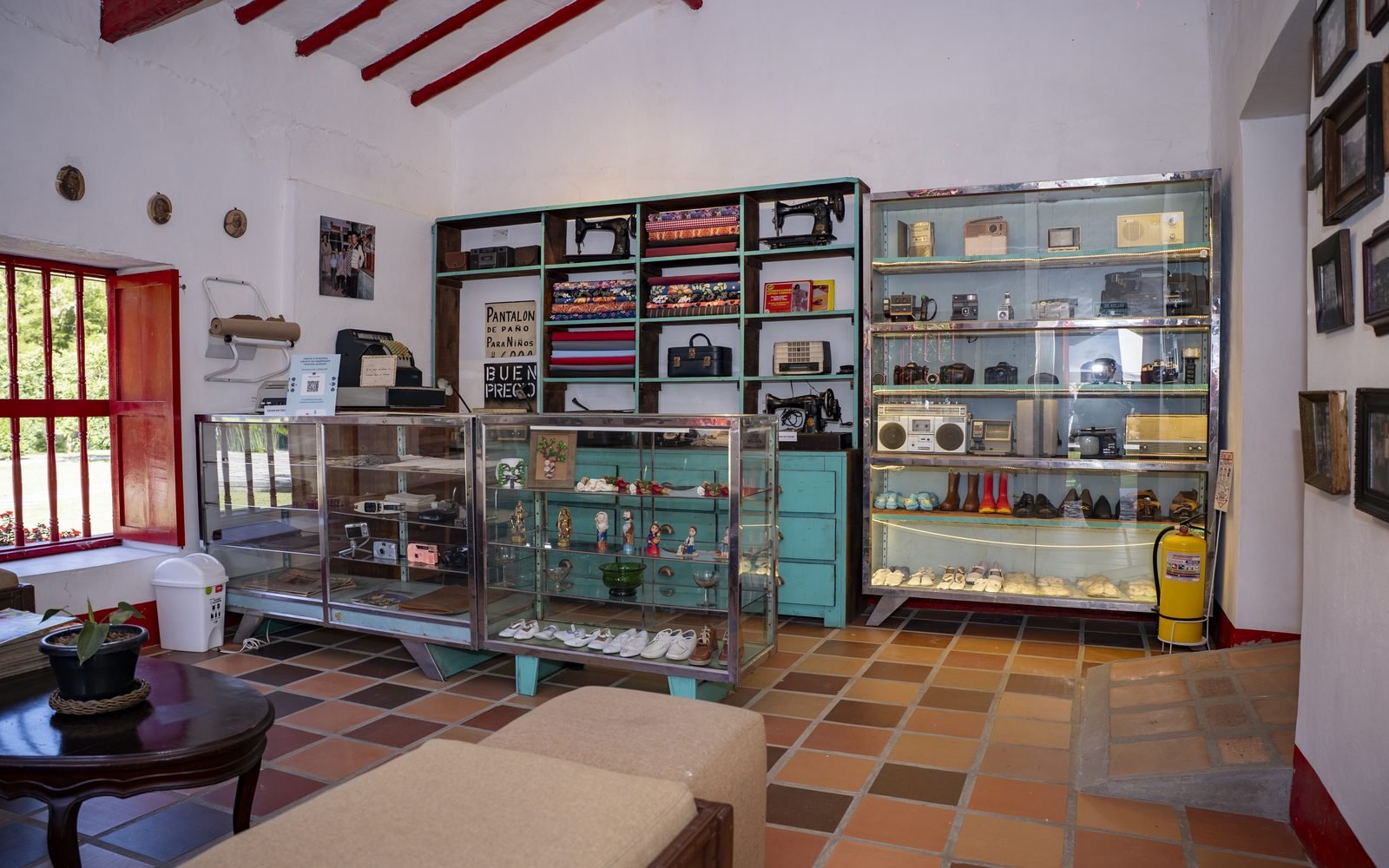
El BaratónEl Baratón
Memoria del comercio santuarianoThe memory of local commerce
Audio en preparación. Las grabaciones de esta sala van en audio/es/11-el-baraton/ y el reproductor se activa solo.
Recording in preparation. This room’s files go in audio/en/11-el-baraton/ and the player activates automatically.
El Baratón: 98 años de historiaEl Baratón: 98 years of history
Este espacio es un homenaje al comercio santuariano y, especialmente, al almacén El Baratón, una institución que ha acompañado la vida de varias generaciones de habitantes de El Santuario.
Durante 98 años, El Baratón ha sido mucho más que un lugar para comprar ropa. Para muchas familias santuarianas, hace parte de sus recuerdos: allí sus padres compraron prendas para ellos, y allí también se encontraron telas, vestidos, zapatos, sombreros y muchos de los objetos que hicieron parte de la vida cotidiana.
This space is a tribute to the commerce of El Santuario and, in particular, to El Baratón, a shop that has accompanied the lives of several generations in this town.
For 98 years El Baratón has been much more than a place to buy clothes. For many local families it is part of their memories: it is where their parents bought their clothes, and where they found fabrics, dresses, shoes, hats and many of the objects that made up everyday life.
Leer el guion completo de la salaRead the full room script
Llegamos a la última sala del recorrido. Es un homenaje al comercio santuariano y, sobre todo, al almacén El Baratón, que desde 1928 hace parte de la vida de varias generaciones. Para muchas familias, El Baratón es más que un almacén. Allí sus padres les compraron la ropa y allí se encontraban telas, vestidos, zapatos, sombreros y tantas cosas de la vida diaria.
La historia empezó con don Delio de Jesús Zuluaga Duque. Hacia 1925, después de prestar el servicio militar en Sonsón, se unió a su padre, don Ramón Emilio Zuluaga, para trabajar como arriero. Si pasó por la Sala de Tertulia, ya lo conoce: es Ramoncito, el Palabrero Mayor, el que dejaba sus historias en suspenso para que los niños volvieran al día siguiente.
Padre e hijo viajaban con sus bestias hasta Medellín. El camino tomaba dos días: el primero llegaban a lo que hoy es la glorieta de Sajonia y el segundo bajaban a Medellín por Santa Elena. Allí conocieron a otros comerciantes y descubrieron una oportunidad.
Fábricas como Coltejer, Fabricato y Rosellón vendían retazos de segunda, con pequeñas fallas o estampados defectuosos. Empezaron a comprarlos y a venderlos, junto con hilaza, en la plaza José María Córdova de El Santuario. Poco a poco, el negocio creció. Los retazos dieron paso a telas de mejor calidad y después a un local que abría sobre todo los fines de semana, donde los santuarianos compraban tela para hacerse su propia ropa.
En esta historia fue fundamental doña Celia Inés Ramírez Orozco, esposa de don Delio, a quien quizá vio en La Sala celebrando sus bodas de plata. En su costurero hacía camisas, delantales, abrigos y los vestidos de primera comunión de muchas niñas del pueblo, para los vecinos y para el propio almacén.
Con el tiempo, El Baratón pasó de vender telas a vender ropa hecha, traída de Medellín y de Bogotá, y fue acompañando los cambios en la manera de vestir de los santuarianos. Después llegaron los sombreros, las ruanas, los zapatos, las botas y hasta los electrodomésticos, como el televisor de 1975 que vio en La Sala.
La historia la continuó don Jaime Zuluaga Ramírez, hijo de don Delio. A los 22 años dejó el seminario y empezó a trabajar con su padre en las cuentas, el inventario y la atención a los clientes. Cuando don Delio murió, quedó al frente del almacén. Es el mismo don Jaime que años después fundó con su familia la Fundación Aurum, a la que pertenece esta casa.
Pero El Baratón también lo hicieron quienes trabajaron allí. Don José Duque, por ejemplo, atendió el almacén durante 40 años. Los sábados y domingos estaba detrás del mostrador y entre semana trabajaba la tierra. A veces hasta sus hijos le ayudaban los fines de semana.
Por eso, cuando pensamos en El Baratón, no pensamos solo en un almacén: pensamos en nuestros padres, en nuestra ropa, en las compras de la familia y en momentos de nuestra propia historia. Y hay algo más: la familia que empezó vendiendo retazos de tela en la plaza hoy impulsa, desde la Fundación Aurum, una academia para formar a quienes trabajan en la confección. El hilo de esta historia sigue.
El comercio también es memoria, y en El Santuario muchas historias empezaron detrás de un mostrador. Gracias por recorrer con nosotros la Casa Museo de El Santuario.
Antes de irse, lo invitamos a responder la encuesta al final de esta página. Son solo dos minutos y nos ayudan mucho a mejorar.
We have reached the last room of the tour. It is a tribute to the commerce of El Santuario and, above all, to the El Baratón shop, which since 1928 has been part of the lives of several generations. For many families, El Baratón is more than a shop. It was there that their parents bought them their clothes, and there you could find fabrics, dresses, shoes, hats and so many things of everyday life.
The story began with don Delio de Jesús Zuluaga Duque. Around 1925, after doing his military service in Sonsón, he joined his father, don Ramón Emilio Zuluaga, working as a muleteer. If you have been through the Sala de Tertulia, the tertulia room, you already know him: he is Ramoncito, the Palabrero Mayor, the one who left his stories hanging so that the children would come back the next day.
Father and son travelled with their animals to Medellín. The journey took two days: on the first they reached what is now the Sajonia roundabout, and on the second they went down to Medellín by way of Santa Elena. There they met other merchants and discovered an opportunity.
Textile mills such as Coltejer, Fabricato and Rosellón sold second-rate remnants, with small flaws or faulty prints. They began buying them and selling them, along with cotton yarn, in the José María Córdova square in El Santuario. Little by little, the business grew. The remnants gave way to better-quality fabrics and later to a shop that opened mainly at weekends, where people from El Santuario bought cloth to make their own clothes.
Doña Celia Inés Ramírez Orozco, don Delio’s wife, whom you may have seen in La Sala, the living room, celebrating their silver wedding anniversary, was essential to this story. In her sewing room she made shirts, aprons, coats and the First Communion dresses of many of the town’s girls, for the neighbours and for the shop itself.
Over time, El Baratón moved from selling fabric to selling ready-made clothes, brought from Medellín and Bogotá, and it kept pace with the changes in the way people in El Santuario dressed. Then came hats, ruanas, shoes, boots and even household appliances, like the 1975 television set you saw in La Sala.
The story was carried on by don Jaime Zuluaga Ramírez, don Delio’s son. At 22 he left the seminary and began working with his father on the accounts, the stock and serving the customers. When don Delio died, he took charge of the shop. He is the same don Jaime who, years later, founded with his family the Fundación Aurum, to which this house belongs.
But El Baratón was also made by those who worked there. Don José Duque, for example, served in the shop for 40 years. On Saturdays and Sundays he stood behind the counter, and during the week he worked the land. Sometimes even his children helped him at weekends.
That is why, when we think of El Baratón, we do not think only of a shop: we think of our parents, our clothes, family shopping trips and moments of our own history. And there is something more: the family that began by selling fabric remnants in the square now promotes, through the Fundación Aurum, an academy to train those who work in garment making. The thread of this story goes on.
Commerce is memory too, and in El Santuario many stories began behind a shop counter. Thank you for touring the Casa Museo de El Santuario with us.
Before you leave, we invite you to answer the survey at the end of this page. It takes only two minutes and helps us a great deal to improve.
¿Cómo le pareció el recorrido?How was your visit?
Sus respuestas nos ayudan a cuidar y mejorar la Casa Museo. Son dos minutos.Your answers help us look after and improve the museum. It takes two minutes.
Responder la encuestaAnswer the survey